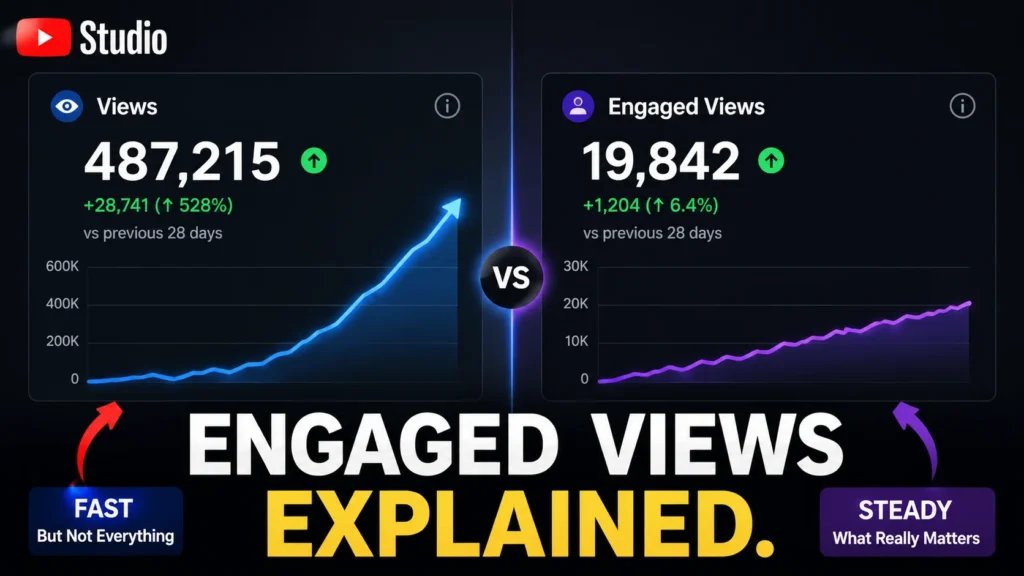
Your view count is about to look better than your channel actually is. That’s not a compliment.
Starting August 24, 2026, YouTube counts a public view the second a video starts playing — first frame, no minimum watch time. Not 30 seconds. Not “watched a meaningful chunk.” The old threshold is gone from the public number. In its place, YouTube kept the original math and gave it a new name: Engaged views, sitting quietly inside YouTube Studio’s Advanced Mode, doing the job the view counter used to do.
I’ve been checking my own channel’s dashboard daily since the rollout started, and here’s the short version: your public views will probably jump. Your engaged views won’t, unless people are actually sticking around. That gap is the whole story.
Author: Javid Malik, Android developer and tech writer at Innvobyte, Pakistan. Published August 24, 2026. Last updated August 24, 2026.
What Is an Engaged View on YouTube?
An engaged view is a view where the viewer kept watching past the first few seconds instead of bouncing immediately. It’s the metric YouTube used to hide behind the plain word “view” — roughly the old 30-second-ish bar, minus the mystery, now given its own label because the public view count no longer means the same thing.
Practically, engaged views live in YouTube Studio → Analytics → Advanced Mode, next to watch time and average view duration. If you’ve never opened Advanced Mode before, this is the week to learn where it is.
Why Did YouTube Change How Views Are Counted?
Because YouTube was running three different rulebooks at once, and it made cross-format comparisons meaningless. Shorts already switched to first-frame counting back in March 2025 to match TikTok and Instagram Reels. Long-form video, podcasts, and live streams were still using an unofficial, never-fully-disclosed watch-time bar. <cite index=”7-1″>YouTube itself said creators wanted to eliminate this metric confusion and accurately understand their true exposure, which is why it’s making this update.</cite>
So now everything counts the same way: press play, it’s a view. That part isn’t complicated. What’s complicated is what people will do with a bigger number.
What Actually Changes for Creators
Here’s where I’ll save you some reading. Almost nothing changes about how you get paid.
<cite index=”8-1″>YouTube confirmed the change does not affect earnings or YouTube Partner Program eligibility — monetization keeps running on Engaged Views and Engaged Watch Hours, both visible in Advanced Mode.</cite> The number that decides your ad revenue was never the flashy public count in the first place; it was always something closer to what’s now called engaged views. That part of the machine didn’t move.
What did move:
- Your public view count will likely climb, sometimes sharply, because plays that used to not count — someone hovering a thumbnail, autoplay starting, a viewer who leaves after two seconds — now register instantly.
- Old videos keep their existing counts. This isn’t retroactive. The new rule applies to plays going forward from August 24.
- Year-over-year reporting breaks. Comparing your July 2026 view count to your September 2026 view count is now comparing two different measuring sticks. Use engaged views for that comparison instead — it’s the metric that didn’t get redefined.
I’ll be honest, I don’t love this change. A bigger number that means less isn’t really a gift to creators — it’s a gift to whoever’s pitch deck needed a bigger number. But I also get why YouTube did it: hiding a threshold for a decade is a defensible anti-bot strategy, and it’s also confusing as hell for anyone trying to compare Shorts to long-form to live.
Views vs. Engaged Views: The Table Nobody Else Is Giving You
| Public Views | Engaged Views | |
|---|---|---|
| When it counts | First frame of playback | After viewer stays past the opening seconds |
| Determines earnings? | No | Yes |
| Determines YPP eligibility? | No | Yes (via qualified views/watch hours) |
| Affected by August 24 change? | Yes — new, lower bar | No — preserves the old definition |
| Best used for | Reach, exposure, top-of-funnel awareness | Performance, retention, brand-deal accuracy, historical comparison |
| Where to find it | Front-facing view counter on every video | YouTube Studio → Analytics → Advanced Mode |
Think of it this way: public views tell you how many people your thumbnail got to press play. Engaged views tell you whether the video was worth pressing play for. Those are two different questions, and until now YouTube only gave you one answer.
The Part Everyone’s Missing: The 2027 Partner Program Change
Buried in the same news cycle is a second, unrelated announcement that matters more for anyone trying to monetize. On August 10, 2026 — two weeks before the view-counting update — <cite index=”8-1″>YouTube announced it is doubling the watch-hour requirement for new Partner Program applicants from 4,000 to 8,000 hours, or from 10 to 20 million Shorts views, effective February 1, 2027.</cite> Existing YPP members keep their current terms.
Don’t let a rising public view count fool you into thinking you’re closer to that bar. A view spike from the new counting method doesn’t move your qualified watch hours or your qualified Shorts views one bit — those thresholds are built on the engaged, attention-based numbers, not the public count. If you’re building toward monetization right now, watch time and engaged views are the only figures that matter. Screenshotting a bigger public view count and calling it progress is the kind of mistake that costs new creators months.
What This Means If You Run Brand Deals
If you’re pricing sponsorships off view count, this is the week to update your media kit language. Say which number you mean. A brand asking “how many views did that integration get” now needs a follow-up question, and smart brands are already asking it.
- Public views = reach. Use it to show exposure, impressions, top-of-funnel scale.
- Engaged views = attention. Use it to prove people actually watched the sponsored segment.
- If a deal is priced per view, clarify which metric the contract references before the invoice goes out, not after.
The Media Rating Council’s viewable video impression standard — the ad industry’s own baseline — requires just two continuous seconds with half the player visible. YouTube’s first-frame counting is looser than even that. The direction across the whole industry is the same: platforms are pushing exposure into the headline number and burying attention one menu deeper.
How to Check Your Own Numbers Right Now
- Open YouTube Studio.
- Go to Analytics.
- Switch to Advanced Mode (top right).
- Add Engaged views as a metric column alongside Views.
- Compare the gap on a video published before August 24 against one published after. The gap tells you how much of your “growth” is real.
Do this before you make any decisions based on a view count screenshot from this week.
FAQ Section
Q1: What is the difference between views and engaged views on YouTube? A1: Views now count from the first frame someone presses play, with no minimum watch time. Engaged views only count when someone keeps watching past the opening seconds, preserving the older, stricter definition YouTube used before August 24, 2026.
Q2: Does the YouTube view count change affect my earnings? A2: No. YouTube has confirmed monetization and ad revenue still run on engaged views and engaged watch hours, not the new public view number. Your payout formula didn’t change — only the front-facing counter did.
Q3: Will my old videos get more views retroactively? A3: No. Existing view counts on videos published before August 24, 2026 stay exactly as they are. The new first-frame counting only applies to plays that happen from that date forward.
Q4: Why is YouTube making this change now? A4: To standardize view counting across Shorts, long-form video, podcasts, and live streams, which previously used inconsistent, partly undisclosed rules. Shorts already switched to first-frame counting in March 2025 to match TikTok and Instagram; this extends the same standard everywhere.
Q5: Does the view count change affect YouTube Partner Program eligibility? A5: No, eligibility is based on qualified watch hours and qualified views, which follow the engaged-view standard, not the new public counter. Note that a separate change is doubling the entry watch-hour requirement for new applicants starting February 1, 2027.
Q6: How should I compare my channel’s performance before and after August 24, 2026? A6: Use engaged views, not public views, for any comparison that crosses the August 24 date. Public view totals from before and after aren’t measuring the same thing, so mixing them in a report will distort your growth numbers.