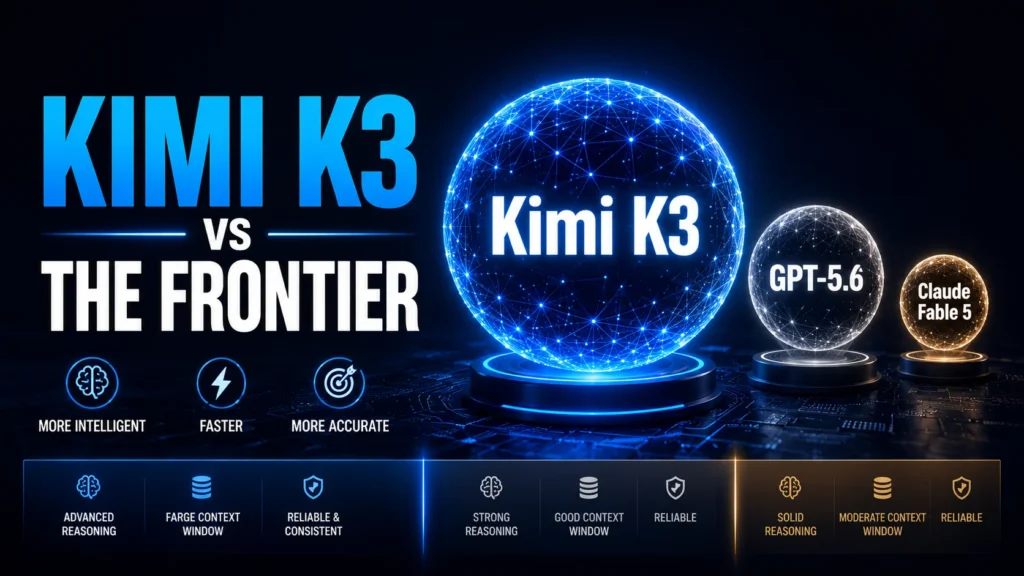
Kimi K3 is Moonshot AI’s newest model, and it’s the largest open-weight AI model ever released at 2.8 trillion parameters. It launched on July 16, 2026, and it beats GLM-5.2 on every published coding benchmark while landing close behind Claude Fable 5 and GPT-5.6 Sol on general intelligence.
That’s the short version. Here’s what actually matters if you’re deciding whether to use it.
What Is Kimi K3?
Kimi K3 is a 2.8 trillion parameter mixture-of-experts model from Moonshot AI, a Beijing startup backed by Alibaba. It’s now the largest open-source AI model in the world, and benchmarks show it performs neck-and-neck with the most powerful proprietary systems from Anthropic and OpenAI.
It runs on Sparse MoE architecture built with Kimi Delta Attention (KDA), a hybrid linear-attention mechanism paired with attention residuals. In plain terms: it’s built to handle long, complicated tasks — think entire codebases or multi-hour agent sessions — without losing track of what it’s doing.
The model has a 1-million-token context window, native visual understanding, and an always-on reasoning mode Moonshot calls “thinking mode.” Full model weights are set to release on July 27, 2026, so right now you can only use it through the hosted API on kimi.com.
Kimi K3 Pricing
Here’s what it actually costs to run:
| Item | Price |
|---|---|
| Input tokens | $3 per million |
| Output tokens | $15 per million |
| Cached input | $0.30 per million |
| Context window | 1,048,576 tokens |
That cached input price matters more than it looks. Mooncake serving keeps coding cache rates above 90%, cutting real input cost close to 4 times lower for repeat coding sessions, which is exactly the kind of workflow Moonshot built this model for.
Compared to other Chinese models, K3 is expensive — it costs $15 per million output tokens, versus $4.40 for z.ai’s GLM-5.2 and just $0.87 for DeepSeek V4. But it’s still cheaper than the equivalent US models — Fable 5 costs $50 for the same amount of output. Moonshot isn’t playing the cheapest-model game anymore. It’s playing the good-enough-and-cheaper-than-Fable game. Kimi K3Kimi K3
Kimi K3 vs Claude Fable 5 vs GPT-5.6 Sol
This is where most people stop reading the press release and start asking the real question: does it actually compete?
On the Artificial Analysis Intelligence Index, Kimi K3 scores about 57, placing fourth overall, behind Claude Fable 5 at roughly 60 and GPT-5.6 Sol at roughly 59, and narrowly ahead of Claude Opus 4.8 at roughly 56. That’s an independent, third-party score, not Moonshot’s own number. Worth trusting more than the vendor chart.
But the composite score hides where K3 actually wins:
- Coding, in general: K3 leads all of them on the Frontend Code Arena, taking the number one spot, and posts the strongest open-weight GPQA Diamond result to date at 93.5%.
- Long coding sessions: On SWE Marathon, which tests lengthy engineering problems over sustained periods, Kimi K3 ranks first with a score of 42.0, ahead of Claude Opus 4.8’s 40.0 and GPT-5.6 Sol’s 39.0.
- General programming: On Program Bench, K3 finishes first overall at 77.8, with GPT-5.6 Sol close behind at 77.6 and Fable 5 at 76.8.
- Short, isolated coding tasks: On DeepSWE, GPT-5.6 Sol leads at 73.0 and Fable 5 follows at 70.0, with K3 a step behind at 67.5.
So it’s not a clean sweep. K3 is genuinely great at long, grinding engineering work, and a step behind on quick isolated coding problems. That’s a useful distinction if you’re picking a model for a specific job instead of a general one.
On agentic work — the stuff that matters if you’re running autonomous workflows — K3 reaches an Elo rating of 1,668 on GDPval v2, beating GLM-5.2, GPT-5.5, and Claude Opus 4.8, though it still falls short of Claude Fable 5’s 1,760.
Head-to-head with GPT-5.6 Sol specifically
Raw head-to-head, K3 posts the higher number on eleven of fourteen published benchmarks — with 7 clear wins, Sol winning 2, and 5 near-ties. That sounds impressive until you remember the Intelligence Index still puts Sol ahead overall. K3’s strongest results share a pattern: tasks that run long, touch many tools, and punish models that lose the thread. Sol still wins on raw single-shot problem solving.
The Catch Nobody’s Skipping Past
Every benchmark chart here comes with an asterisk, and it’s worth knowing before you trust any of it.
Different benchmarks used different agent harnesses for K3 — Kimi Code Bench used KimiCode and Claude Code, Claude and GLM models used Claude Code, and GPT used Codex. That’s not a neutral comparison. It’s each lab getting to run its own model on its home turf. On DeepSWE specifically, Moonshot’s own KimiCode harness gave K3 a 67.5, but the common mini-SWE-agent harness — the one used to score everyone else — put it at 67.3, which lands closer to GPT-5.5 territory and well below GPT-5.6 Sol’s 73.
There’s also a quieter problem. Independent testing by Artificial Analysis largely confirms Moonshot’s results, though K3’s hallucination rate increased compared to its predecessor. A model that’s better at long coding marathons but more prone to making things up isn’t automatically a better model for production use. That tradeoff deserves more attention than it’s getting in most of the launch coverage.
Why This Release Actually Matters
The release lands right before the 2026 World Artificial Intelligence Conference in Shanghai, and marks a comeback for Moonshot after its market position eroded over the past 18 months following DeepSeek’s rise. This isn’t just another model drop. It’s Moonshot trying to reclaim relevance in a market DeepSeek and GLM have been eating into.
It’s already got real adoption too — Cursor used earlier Kimi models to help build its Composer 2 coding agent, DoorDash delegates lower-level engineering work to Kimi K2.6, and Thinking Machines used Kimi K2.5 to generate early training data for its Inkling model. Labs aren’t just benchmarking Kimi models. They’re building on them. Kimi K3
Moonshot itself says K3 outperforms all rivals except Claude Fable 5 and GPT-5.6 Sol on overall capability. That’s an honest admission from the company, and it lines up with what the independent numbers show. K3 isn’t the best model in the world. It’s the best open-weight model in the world, by a wide margin, and that’s a different and arguably more useful title.
Is Kimi K3 Worth Using?
Depends what you’re doing.
If you’re running long, multi-hour coding sessions or agentic workflows and want something you can self-host once the weights land on July 27, K3 is the strongest open option available, full stop. Nothing else in the open-weight category comes close on the numbers we’ve seen.
If you need the single best model regardless of cost and don’t care about open weights, Fable 5 and GPT-5.6 Sol still edge it out on broad intelligence and single-shot coding tasks.
If cost-per-task is your main constraint, K3 lands at roughly $0.94 per task on some evaluations — similar to GPT-5.6 Sol and about half the price of Opus 4.8. That’s a real advantage if you’re running this at scale.
FAQ SECTION:
Q1: What is Kimi K3?
A1: Kimi K3 is a 2.8 trillion parameter open-weight AI model from Moonshot AI, released on July 16, 2026. It has a 1-million-token context window, native vision support, and is currently the largest open-source AI model ever released.
Q2: When do Kimi K3’s model weights release?
A2: The model is live now on kimi.com through the hosted API, but the full open-weight model files are scheduled to release on July 27, 2026, letting developers download and self-host it.
Q3: Is Kimi K3 better than Claude Fable 5?
A3: Not overall. On the independent Artificial Analysis Intelligence Index, K3 scores around 57 versus Fable 5’s roughly 60. K3 does beat Fable 5 on specific coding benchmarks like Frontend Code Arena and SWE Marathon.
Q4: How much does Kimi K3 cost to use?
A4: K3 costs $3 per million input tokens and $15 per million output tokens, with cached input priced at just $0.30 per million. That’s pricier than DeepSeek V4 but far cheaper than Claude Fable 5’s $50 per million output tokens.
Q5: Is Kimi K3 good for coding?
A5: Yes, especially for long, sustained coding sessions. It ranks first on SWE Marathon and Program Bench, though it trails GPT-5.6 Sol and Fable 5 slightly on shorter, isolated coding tasks like DeepSWE.
Q6: Does Kimi K3 have any downsides?
A6: Its hallucination rate increased compared to its predecessor K2.6, according to independent testing. Its benchmark results also mix different testing harnesses across models, so some comparisons are less apples-to-apples than they first appear.