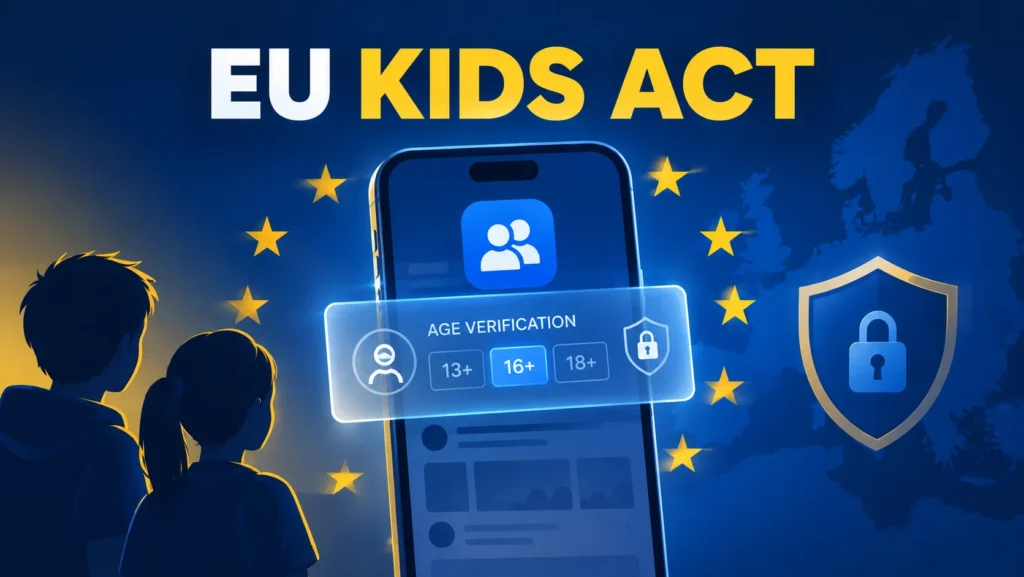
The European Commission wants to stop kids under 15 from opening their own social media, gaming, or AI chatbot accounts, unless a parent sets one up for them. That’s the core of the EU Kids Act, a draft law due for formal presentation on September 17, 2026, and it’s the broadest child-safety proposal any major regulator has put on paper so far.
I’ve spent the last two days going through the leaked draft and the reporting around it. Here’s what’s actually in the plan, what’s still just a proposal, and what it means if you build, run, or use any product a teenager might touch.
What Is the EU Kids Act?
The EU Kids Act is a draft European Union law that would set minimum ages and design rules for social media, video-sharing platforms, online games, and AI chatbots. Under-15s couldn’t open their own accounts on higher-risk platforms without a parent doing it for them, and companies would have to verify age and strip out addictive design features like autoplay and endless scroll for young users.
It isn’t law yet. Commission President Ursula von der Leyen and tech chief Henna Virkkunen are set to present the full text on Thursday, September 17, and even after that, it still needs sign-off from EU member states and the European Parliament — a process that typically takes months, sometimes years, before it’s fully binding.
Who Does the EU Kids Act Actually Cover?
This is where the draft goes further than most people expected. It isn’t just Instagram and TikTok.
The scope turned out broader than early reporting suggested. Beyond social media and video-sharing apps, the bill folds in online games and AI companions too — reportedly at the request of Spain and the Netherlands. The draft groups all of these together as services carrying “specific design risks for minors,” and it singles out AI chatbots and companions specifically because they can act like a stand-in advisor for a child’s mental health or personal decisions, which is a very different risk profile than a static video feed.
One useful carve-out: services built for schools or run by public authorities, along with AI tools meant for office or industrial use, sit outside the scope entirely. So a school’s learning platform or a workplace AI assistant isn’t caught up in this — a general-purpose consumer chatbot like ChatGPT, Claude, or Gemini is a different story if a teenager can sign up for it directly.
The Age Ladder, Tier by Tier
The draft sets up a graduated system rather than a hard wall at one age. Here’s how it breaks down, based on the reported text:
| Age group | What they can access |
|---|---|
| Under 3 | No access to social media, video-sharing, gaming, or chatbot services at all |
| 3–12 | Parent-controlled accounts only, and only on services built specifically for children |
| 13–14 | A parent can open an “introductory” account with limited contacts and hard screen-time limits |
| 15+ | Can open their own account independently, no parental sign-off required |
A 12-year-old gets nothing without a parent behind the account. A 14-year-old gets a starter account a parent has to switch on, with a leash on who can message them and how long they can stay logged in. Turn 15, and the leash comes off.
Does This Actually Ban AI Chatbots for Teens?
Not a full ban — but it does put general-purpose AI chatbots and “AI companions” under the same age-tier and verification rules as social media. That’s a meaningful shift, because right now most consumer AI chatbots rely on a self-declared birthdate at sign-up, which any determined 12-year-old can lie their way past in about five seconds. This proposal would force actual age verification for EU users, the same way social platforms would have to do it.
It’s worth saying plainly: this isn’t happening in a vacuum. OpenAI already rolled out a separate under-18 experience for ChatGPT with parental account linking and stricter content rules, well before this EU proposal existed. The industry was already drifting toward age-gating “companion”-style AI on its own — Brussels is mostly formalizing a direction the bigger players had already started moving in.
What Would Platforms Have to Actually Do?
The draft pairs the age tiers with design obligations that apply no matter which tier a user falls into:
- Verify age at sign-up. Social media and video-sharing platforms would need to check age every time someone opens a new account, not just take their word for it.
- Verify age before download for games. Game platforms would need to confirm age before installation completes, not after the fact.
- Kill addictive design patterns for minors. Autoplay, endless scroll, streaks, and aggressive push notifications would need to be dialed back or switched off for underage accounts.
- Give kids an easy way to report harm. Simple, visible reporting tools instead of buried settings menus.
- Hand parents real controls. Screen-time limits, contact restrictions, and activity visibility for the 13-14 tier.
- Pay a supervisory fee. Companies would help fund the enforcement body checking compliance, similar to how the Digital Services Act already works for large platforms.
None of this is coming out of nowhere. The Commission already has related infrastructure running: it published draft guidelines on protecting minors under the Digital Services Act in May 2025 and finalized them that July, alongside a prototype age-verification app. The Kids Act is effectively the next, more binding layer stacked on top of that groundwork.
Why Now — and Why It’s Bigger Than Just the EU
Brussels isn’t acting alone here. The UK government opened a consultation last month on an Australian-style social media ban for under-16s, and Spain, Greece, and Slovenia have each signaled plans for their own bans. Australia already went further and enforces a flat under-16 cutoff, making it the first country to actually block minors from social platforms outright. Scrutiny of AI chatbots specifically ramped up after Elon Musk’s Grok was caught generating nonconsensual sexualized images — a big part of why chatbots got folded into this bill rather than left for a later one.
Here’s how the EU’s draft stacks up against what’s already happening elsewhere:
| Region | Minimum age | Status | Covers AI chatbots? |
|---|---|---|---|
| European Union (EU Kids Act) | 15 for independent accounts (tiered access below that) | Draft proposal, presented Sept 17, 2026 | Yes — explicitly named in scope |
| Australia | 16, hard cutoff | Already in force | No — social media platforms only |
| United Kingdom | 16 proposed | Under consultation | Being added to close a gap in the existing Online Safety Act |
The EU’s version is actually softer than Australia’s flat 16-and-out rule, since it lets 13- and 14-year-olds onto a supervised starter account rather than banning them outright. But it’s broader in scope, because it folds in AI companions and video games from day one instead of bolting them on years later the way Australia and the UK are still working through.
What Happens Next
This is a proposal, not a finished law, and it’s worth being honest about the timeline:
- September 17, 2026 — Von der Leyen and Virkkunen formally present the EU Kids Act.
- Negotiation phase — EU member states and the European Parliament debate and amend the text. Exact age cutoffs and the fee structure could still shift during this stage.
- Adoption — Once agreed, it becomes binding EU law, though individual provisions usually get a grace period before enforcement actually starts.
- Enforcement — Rolls in under a structure similar to the Digital Services Act, with the Commission overseeing the largest platforms directly.
None of this happens overnight. The DSA itself took years to go from proposal to full enforcement, and there’s no real reason to expect the Kids Act to move dramatically faster, even with the current political pressure.
What This Means for Developers and Creators
If you build apps, run anything with a social or messaging feature, or ship an AI chatbot with EU users, this is worth tracking closely even before it’s finalized. The direction is clear, and age-verification infrastructure is coming either way. For content creators covering AI and tech news, this is also a genuinely good story to get ahead of — search interest is spiking well before the formal presentation, and most of what’s currently ranking is thin wire-service copy that a properly structured explainer can outrank.
If your product currently relies on a self-declared birthdate as its only age check, that’s the exact gap this legislation targets. It’s also the same gap several US states have already started closing through their own AI companion laws, so this isn’t a problem you can file away as purely European.
Bottom Line
The EU Kids Act would set 15 as the age for independent social media and AI chatbot accounts, with a tiered system below that, and it explicitly pulls AI companions into the same rulebook as social platforms for the first time. It’s not law yet. It’s a proposal being presented September 17, 2026, and it still needs approval from EU governments and Parliament. But given the direction every major regulator is already moving, treat real age verification as a “when,” not an “if.”
For more on how AI companies are already reacting to youth-safety pressure ahead of regulation, see our coverage of OpenAI’s age-prediction rollout for ChatGPT and our breakdown of how Android’s parental controls compare to what regulators are now demanding. And if you’re tracking the broader AI-safety enforcement trend, our piece on Anthropic’s threat intelligence findings on chatbot misuse is a useful companion read.
FAQ SECTION:
Q1: What is the EU Kids Act? A1: The EU Kids Act is a draft EU law that would set minimum ages for social media, video-sharing, gaming, and AI chatbot accounts. Under-15s would need a parent to open accounts on their behalf, with full independent access starting at 15.
Q2: Is the EU Kids Act already law? A2: No. It’s being formally presented on September 17, 2026, and still needs approval from EU member states and the European Parliament before it takes effect. Expect the process to take months at minimum.
Q3: Does the EU Kids Act ban AI chatbots like ChatGPT for kids? A3: Not an outright ban, but it puts general-purpose AI chatbots and AI companions under the same age-tier and verification rules as social media, meaning under-15s couldn’t sign up independently.
Q4: What age can teens use social media under the EU Kids Act? A4: Fifteen is the age for fully independent accounts. Thirteen- and fourteen-year-olds could use a parent-created “introductory” account with limited contacts and screen-time caps.
Q5: How is age actually going to be verified? A5: Platforms would need to verify age when a user opens a new account, and game platforms would verify before allowing a download. The Commission already has a prototype age-verification app in testing from its 2025 Digital Services Act guidance.
Q6: How does the EU’s approach compare to Australia’s social media ban? A6: Australia already enforces a flat under-16 ban on social media with no tiered access. The EU’s draft sets a lower independent-access age of 15 but is broader in scope, explicitly covering AI chatbots and games from the outset.