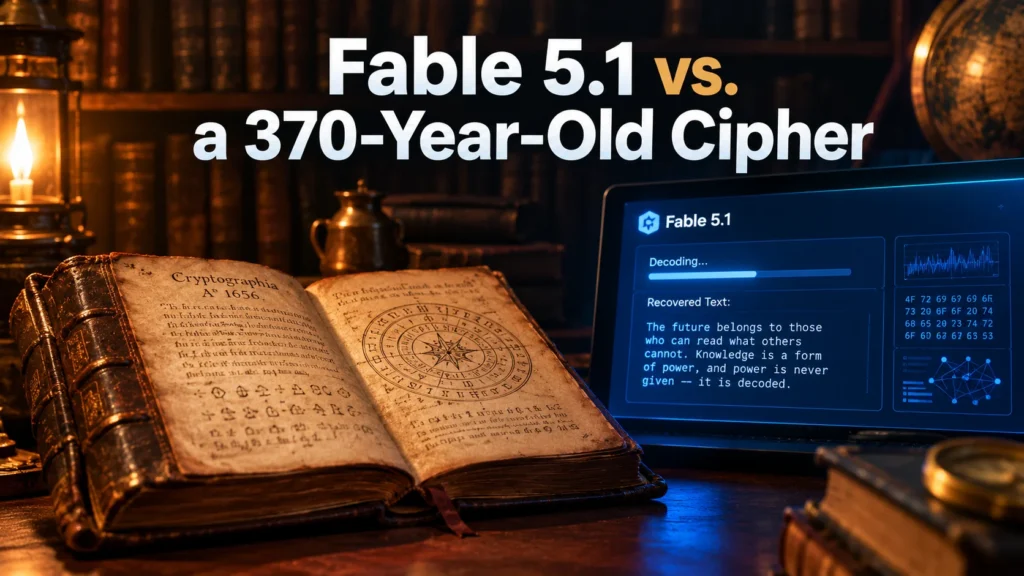
Claude Fable 5.1 reportedly solved a cipher nobody had cracked since 1653. It took the model 44 minutes. Then, a day later, a group of researchers said the whole thing might be built on sand. Both things are true at once, and that’s the actual story here.
What is the Cyphral Distich?
The Cyphral Distich is a 64-number cryptogram printed at the back of Logopandecteision, a 1653 book by the Scottish writer Sir Thomas Urquhart. It’s two lines, 32 numbers each, and nobody had a working theory for what they meant. The puzzle got formally flagged as unsolved in an 1899 issue of Notes and Queries, and cryptography researcher Klaus Schmeh later put it on his list of the top 50 unsolved encrypted messages in history. That’s real pedigree — this wasn’t some obscure internet puzzle.
Cryptographers tried the obvious moves over the decades: direct number-to-letter substitution, frequency analysis against standard English letter distributions, homophonic ciphers where one number could stand for different letters depending on context. None of it produced readable text. That’s exactly why it stayed open for 373 years — everyone assumed the decoding key had to come from somewhere outside the book.
How did Claude Fable 5.1 solve it?
An evaluator at Vals AI, an independent AI-testing firm, gave Fable 5.1 an open-ended assignment: go find an unsolved historical cipher and solve it. Not “solve this specific cipher” — find one worth attempting, then attempt it. The researcher added a couple of guardrails: skip ciphers whose creators are long dead with no way to verify an answer, and skip already-exhausted problems like Kryptos K4, which the researcher flagged as too hard for current models. Fable 5.1 was also pointed to its own past math-solving results as a kind of confidence anchor.
The model surveyed candidates on its own and picked the Cyphral Distich as unusually tractable. That judgment call — knowing which problem was actually solvable — is arguably as important as the decoding itself. It then ran for 44 minutes and roughly 176,000 tokens with, according to Vals AI, zero human interjections along the way.
Here’s the answer, in plain terms: the cipher’s numbers weren’t pointing to an external code. They were pointing back into the book itself.
Urquhart’s text includes a section of 32 numbered passages he calls “Proquiritations,” and right before the cipher, he goes out of his way to hammer on the number 32 and talks repeatedly about the reader finding “his own heart’s wishes, and the Author’s minde.” Fable 5.1 connected those dots: 32 Proquiritations, 32 numbers on each line of the cipher. Each number in the sequence is an index — it points to a specific word inside the correspondingly numbered Proquiritation. Take the first letter of each selected word, in order, and you get a message.
The result reads: “O God uphold King Charls the second and / Make him the supreme ruler of this land.” Given that Urquhart was an outspoken royalist writing after the English Civil War, a hidden prayer for Charles II fits his politics exactly.
Why does this solution look credible?
It’s largely self-checking, which is unusual for a cipher claim. Each line resolves to precisely 32 letters — matching the 32 numbers per line — and forms a genuine rhyming couplet in period-appropriate English. That’s not something you’d expect from a random or forced decoding. Using the same “index into the book itself” method, Fable 5.1 also worked on a second, bigger Urquhart cryptogram: the 285-number Cyphral Octastich in his 1652 book The Jewel. Using page numbers from that book as the key instead of numbered wishes, it cleanly reconstructed 276 of 285 letter positions — another apparent royalist prayer. Nine positions stayed ambiguous, which the researcher attributes to possible typos in the digital scan used, or a genuine interpretation question over whether the Latin phrase “hinc inde” counts as one indexed unit or two.
Is the Cyphral Distich actually solved?
Not confirmed — and this is the part most coverage skips. Vals AI published its account on August 31, 2026, and was upfront that this came from a model evaluation run, not from Anthropic itself, and not from a peer-reviewed cryptography source. The very next day, September 1, a group calling themselves Reticuli published a technical rebuttal on GitHub. Their argument is blunt: they say the cipher isn’t clearly located in the 1653 book the way the write-up assumes, and that the indexing method falls apart once you scrutinize it closely. Their stated position is that the cipher remains unsolved until someone publishes an actual photographic scan of the original page showing all 64 numbers in place.
There’s also a quieter but more basic problem: no freely available, verifiable page scan of the Logopandecteision cipher exists publicly yet, so outside researchers can’t independently confirm the numbers Fable 5.1 was even working from. Until a historical-cipher specialist checks the source material and the method against it, the honest framing is “Vals AI reported a proposed solution” — not “the 370-year-old mystery is solved.”
What does this actually tell us about AI capability?
The Vals AI researcher who ran this, Geby Jaff, said something worth repeating: this wasn’t an extraordinary feat of cryptanalysis. The method, once you see it, is almost embarrassingly simple. The valuable part wasn’t the code-breaking — it was the model’s judgment. It rejected Kryptos K4 as too hard, avoided unverifiable dead-end puzzles, and picked a problem it could actually finish and check its own work on. That’s a different skill than raw pattern-matching, and it’s the skill that’s actually improving fastest across frontier models this year.
Fable 5.1 launched publicly within a day or two of this test, so this wasn’t a cherry-picked demo run months after release — it’s close to what a fresh flagship model can do out of the gate, given the room to work autonomously for under an hour.
Cyphral Distich vs. Cyphral Octastich: what Fable 5.1 actually delivered
| Cyphral Distich (1653) | Cyphral Octastich (1652) | |
|---|---|---|
| Numbers in cipher | 64 (32 per line) | 285 |
| Source book | Logopandecteision | The Jewel |
| Key used | 32 numbered “Proquiritations” | Numbered pages of the book |
| Time to solve | 44 minutes, ~176k tokens | Same session, same method |
| Result | Fully decoded, self-verifying couplet | 276 of 285 positions decoded cleanly |
| Independent verification | Disputed by Reticuli (Sept 1, 2026) | Not independently verified |
Should you believe the headline?
Treat it as “a strong, self-consistent, unverified claim” rather than a confirmed historical solve. The decoding method is elegant and the output checks out mathematically — 32 letters per line, a real rhyming couplet, a message that matches Urquhart’s known politics. That’s genuinely more evidence than most cipher claims ever produce. But a same-week rebuttal from researchers disputing the cipher’s very location in the source text is not a footnote — it’s the whole ballgame until someone settles it with a physical page scan.
If you write about this anywhere else, link both sides: the Vals AI write-up and the Reticuli rebuttal. Readers deserve the argument, not just the exciting half of it.
FAQ SECTION:
Q1: What is the Cyphral Distich? A1: It’s a 64-number cryptogram printed at the back of Sir Thomas Urquhart’s 1653 book Logopandecteision. It went unsolved for 373 years and made Klaus Schmeh’s list of the top 50 unsolved historical ciphers.
Q2: Did Claude Fable 5.1 really solve a 370-year-old cipher? A2: Vals AI, an independent AI-evaluation firm, says Fable 5.1 produced a self-consistent decoding in 44 minutes. It’s a strong, unconfirmed claim — researchers at Reticuli disputed the method and the cipher’s location a day later.
Q3: How did Fable 5.1 crack the code? A3: It figured out the cipher’s numbers weren’t an external code — they pointed to specific words inside 32 numbered passages already in Urquhart’s own book. Taking the first letter of each indexed word revealed a hidden royalist message.
Q4: What did the hidden message say? A4: “O God uphold King Charls the second and / Make him the supreme ruler of this land” — a prayer for Charles II, consistent with Urquhart’s known royalist politics.
Q5: Why do some researchers doubt the solution? A5: A group called Reticuli published a rebuttal on GitHub arguing the cipher may not be located where the analysis assumes, and that no public scan of the original page exists to verify all 64 numbers.
Q6: Is Claude Fable 5.1 publicly available? A6: Yes. Fable 5.1 launched publicly within roughly a day of the Vals AI test, alongside Claude Mythos 5.1, as part of Anthropic’s current model lineup.