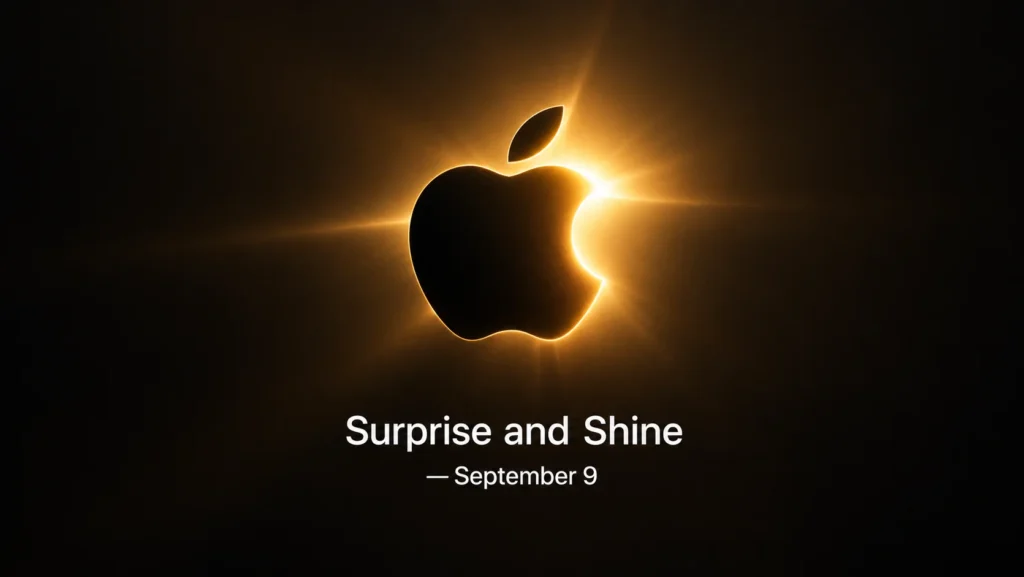
Apple is holding its iPhone event on September 9, 2026, at 10 a.m. Pacific Time from Apple Park. That part is confirmed. Everything else — the actual phones, prices, and specs — is still rumor until John Ternus walks on stage and says otherwise.
This is Ternus’s first keynote as Apple’s CEO, since he took over from Tim Cook on September 1. That alone makes this a different event than the last decade of iPhone launches, even before you get to the hardware.
Quick answer: Apple has confirmed only the date, time, and tagline (“Surprise and Shine”). The iPhone 18 Pro, iPhone 18 Pro Max, and Apple’s first foldable phone — expected to be called the iPhone Ultra — are all still unconfirmed leaks, though they’re backed by enough supply-chain reporting that most outlets treat them as near-certain.
What Apple Has Actually Confirmed
Not much, and that’s normal. Apple confirmed the date and time on August 26. It confirmed the tagline. It confirmed the venue. It did not confirm a single product name, spec, or price.
That distinction matters more than most coverage lets on. When you read “iPhone 18 Pro will have a 2nm chip,” what that really means is: TrendForce, a Taiwanese supply-chain research firm, and a handful of known leakers with decent track records all point the same direction. It’s reliable-ish. It’s not official.
Is the Foldable iPhone Really Called “iPhone Ultra”?
Nobody knows for sure, including Apple’s own supply chain sources — the name is a rumor, not a leak from an internal document. “iPhone Ultra” is the name most reporters have settled on, but Apple has trademarked other names before and gone a different direction at the last minute.
What’s more solid is the design. The foldable is expected to use a book-style hinge — closed, it works like a normal phone with a 5.3 to 5.5-inch outer screen. Open it up and you get a 7.6 to 7.8-inch inner display, closer to an iPad mini than a phone.
Reported details worth knowing:
- Titanium frame, aimed at keeping the folded device thin
- A crease that Apple is trying to make close to invisible, not fully gone
- Touch ID built into the power button instead of Face ID, at least on this model
- Two front cameras (one for each screen state) plus a dual rear camera system
If that Touch ID detail holds up, it would be the first new iPhone since the iPhone SE line to drop Face ID as the primary way to unlock the phone. That’s a bigger behavioral change for daily use than most people are talking about.
How Much Will the Foldable Cost?
TrendForce estimated a starting price between $2,099 and $2,299 in the US, with higher-storage configurations pushing past that. For context, that’s roughly double what a standard iPhone costs and about $700-900 more than an iPhone 17 Pro Max.
We’d take that price seriously. A first-generation folding phone with a titanium frame and dual displays is not going to launch as an impulse buy — Samsung’s own foldables have carried premium pricing for years, and Apple rarely undercuts a category it’s entering late.
iPhone 18 Pro and Pro Max: The Less Flashy, More Practical Upgrade
The Pro line isn’t the headline this year, but it’s the phone most people will actually consider buying. Here’s how the rumored specs stack up against what’s already on shelves.
| Feature | iPhone 18 Pro (rumored) | iPhone 17 Pro (current) |
|---|---|---|
| Chip | A20 Pro, 2nm process | A19 Pro, 3nm process |
| Main camera | Variable aperture (ƒ/1.4-ƒ/2.4, rumored) | Fixed ƒ/1.78 |
| Modem | Apple C2 (in-house, rumored) | Qualcomm |
| Dynamic Island | Roughly 35% smaller (rumored) | Standard size |
| RAM | 12GB | 12GB |
| Starting price (US) | $1,249-$1,399 (estimated) | $1,099 |
The variable aperture camera is the one upgrade worth getting excited about. Every iPhone camera so far has used a fixed opening — you can’t physically change how much light hits the sensor. A variable aperture lets the lens open wider in low light and close down for sharper daytime shots, the same principle high-end mirrorless cameras use. If Apple actually ships this on the main 48MP lens, it’s the most meaningful iPhone camera hardware change since the move to triple cameras.
The A20 Pro chip on a 2nm process should bring a real efficiency jump too, not just a speed bump on paper. Smaller process nodes usually mean better battery life at the same performance level, which matters more day-to-day than raw benchmark numbers.
One rumor we’re skeptical of: claims of on-device 8K video recording. It’s floated around a few rumor roundups, but the more reliable supply-chain sources haven’t backed it up. Treat that one as speculative until Apple actually says it.
Why There’s No Standard iPhone 18 This Year
Apple is reportedly splitting its lineup for the first time in years. The standard iPhone 18 and a new, cheaper iPhone 18e are expected to launch separately in spring 2027, not alongside the Pro models this month.
That leaves Tuesday’s event centered entirely on premium hardware — the Pro line and the foldable — both priced well above what most iPhone buyers currently spend. If you were hoping for a budget refresh this fall, it’s not coming until next year.
Should You Buy or Wait?
If you’re on an iPhone 15 or older, the A20 Pro chip and variable aperture camera are real enough upgrades to justify waiting for September 9 rather than buying a discounted 17 Pro right now.
If you’re already on a 16 Pro or 17 Pro, this is an incremental year for you specifically. The camera upgrade is genuinely interesting, but it’s not going to make your current phone feel outdated the way, say, the jump to Face ID did back in 2017.
If you’ve been eyeing a foldable, the iPhone Ultra is the first one worth considering if you’re locked into iOS — but at $2,099-plus, you’re paying a first-generation tax for a device category Samsung has been refining since 2019. There’s nothing wrong with waiting for the second or third version.
How to Watch
Apple will stream the keynote on apple.com, on YouTube, and through the Apple TV app, starting at 10 a.m. Pacific / 1 p.m. Eastern on September 9. Like recent years, expect a pre-recorded, cinematic-style presentation rather than a live stage show.
FAQ SECTION:
Q1: What time is Apple’s September 9 event? A1: The event starts at 10 a.m. Pacific Time (1 p.m. Eastern) on Wednesday, September 9, 2026. It streams live on apple.com, YouTube, and the Apple TV app.
Q2: What is the foldable iPhone going to be called? A2: Most reports point to “iPhone Ultra,” but Apple hasn’t confirmed a name. It’s the most commonly repeated rumor, not an official detail, so treat the name itself as unconfirmed until launch.
Q3: How much will the iPhone Ultra foldable cost? A3: TrendForce estimates a starting price between $2,099 and $2,299 in the US, with higher storage tiers likely going above that. Apple hasn’t confirmed pricing yet.
Q4: Is the standard iPhone 18 launching in September? A4: No. Current reporting says the standard iPhone 18 and a new iPhone 18e are delayed to spring 2027, leaving this event focused on the Pro models and the foldable.
Q5: What chip is in the iPhone 18 Pro? A5: Rumors point to an A20 Pro chip built on a 2nm process, a step up from the iPhone 17 Pro’s A19 Pro. Apple typically confirms chip details on stage, so this remains unofficial until then.
Q6: Is the iPhone 18 Pro worth upgrading to from a 17 Pro? A6: It’s an incremental upgrade if you already own a 16 Pro or 17 Pro. The variable aperture camera is the standout feature, but it’s not a dramatic enough jump to make your current phone feel outdated.