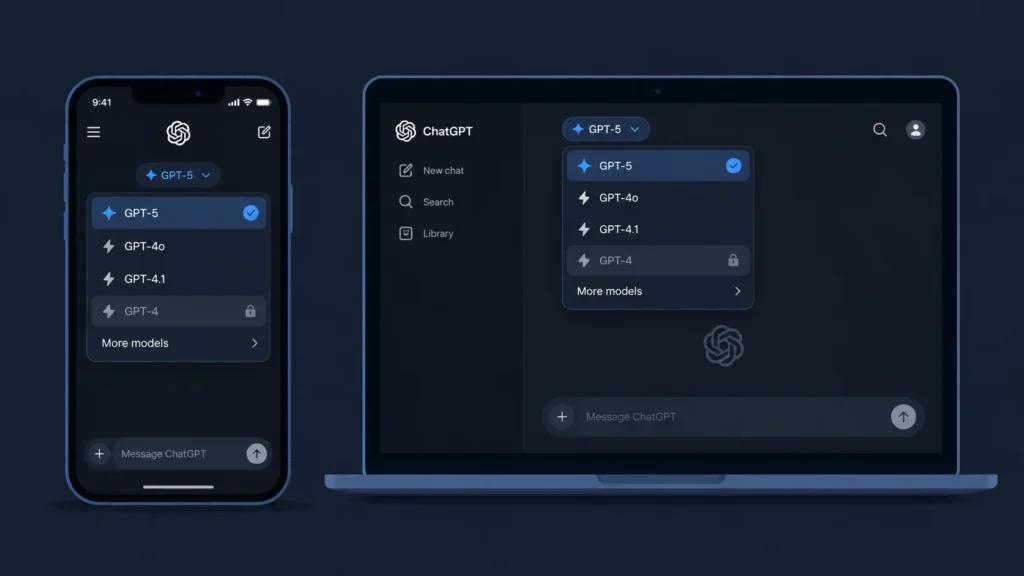
If you’re on ChatGPT Plus and can’t find GPT-6 Astra in the model picker, you’re not missing a setting. Plus gets Astra through ChatGPT Work and Codex, not the regular Chat mode, where it shows up as “GPT-6 Pro” for Pro, Business, and Enterprise accounts only. That’s the whole confusion in one sentence.
OpenAI released GPT-6 Astra on September 3, 2026, and by most accounts it’s a real jump — faster computer use, better long-horizon coding, and the first model OpenAI has rated at a “Critical” cybersecurity capability level. But the rollout announcement and the Help Center page told two slightly different stories, and Plus users got caught in the gap.
What Is GPT-6 Astra?
GPT-6 Astra is OpenAI’s new flagship model, built for long-running agentic work — software engineering, deep research, document creation, and tasks that involve controlling a browser or computer directly. The API model ID is gpt-6-astra, it ships with a 1.05-million-token context window, and it tops out at 128,000 tokens of output.
The name is confirmed, not a leak. OpenAI’s own announcement uses “GPT-6 Astra” throughout, and it’s the successor to GPT-5.6 Sol.
Why Can’t I Find GPT-6 Astra on ChatGPT Plus?
Because it isn’t in the Chat picker for Plus accounts. It never was, on day one. OpenAI’s Help Center is direct about this: Astra shows up in ChatGPT Chat as “GPT-6 Pro” only for the $100 Pro, $200 Pro, Business, and Enterprise plans. Plus users get Astra, just through a different door — ChatGPT Work and Codex.
That distinction is easy to miss because OpenAI’s own posts didn’t emphasize it consistently. The September 3 announcement said Astra would roll out “to all ChatGPT Plus, Pro, Business, and Enterprise users,” which reads like blanket access. A day later, OpenAI’s Codex and ChatGPT lead Thibault Sottiaux posted that Astra was “now rolled out to all Plus and Business users too” — again, without naming a surface. Put both statements next to the Help Center page and you get the real picture: Work and Codex access for Plus was done, Chat access was never on the table.
Here’s the access table as it stood on September 4-5:
| Plan | Chat picker | ChatGPT Work | Codex |
|---|---|---|---|
| Free | No | No | Terra only |
| Go | No | No | Terra only |
| Plus | No | Yes | Yes |
| Pro ($100/mo) | Yes, as “GPT-6 Pro” | Yes | Yes |
| Pro ($200/mo) | Yes, as “GPT-6 Pro” | Yes | Yes |
| Business | Yes | Yes | Yes |
| Enterprise | Yes (off by default) | Yes | Yes |
We pulled up a Plus account after the September 4 rollout and confirmed it firsthand: no Astra or “GPT-6 Pro” entry anywhere in the standard Chat model picker, but Astra-powered runs were available through Work and Codex tasks. That matches the Help Center wording exactly, not the more optimistic reading of the announcement thread.
The Reasoning-Level Trap
There’s a second, more mechanical reason Plus can’t just “get” GPT-6 Pro later. ChatGPT’s model picker now organizes reasoning effort into tiers — Instant, Medium, High, Extra High, and Pro. GPT-6 Pro sits inside that Pro tier, next to GPT-5.6 Sol Pro. Plus accounts don’t have a Pro tier slot at all. It’s not a queue you’re waiting in; it’s a door your plan doesn’t have a key for. If that changes, it’ll show up on the Help Center page first, and probably in a picker redesign, not a quiet server-side flip.
What About Usage Limits and Credits?
Astra usage is folded into each plan’s existing subscription allowance, and OpenAI says users and businesses can buy extra credits for more usage. One catch worth knowing: buying credits does not get you early access to a surface you don’t already have during a staged rollout. If Chat access hasn’t reached your plan, more credits won’t unlock it.
For reference, Pro accounts get specific weekly caps once Astra reaches Chat — reports point to figures like 200 messages a week on the $200 tier — though OpenAI hasn’t published a single definitive limits page for every plan at once, so treat exact numbers as a moving target through September.
Is GPT-6 Astra Actually Better Than GPT-5.6 Sol?
In the areas OpenAI is pushing hardest — agentic execution, computer use, coding, and cybersecurity — yes, and not by a small margin. On OSWorld 2.0, a computer-use benchmark, Astra scores 72.6% against Sol’s 65.7%. On Terminal-Bench 4.0, a coding-agent test, Astra jumps to roughly 57.7-57.9% from Sol’s 37.3%. On AutomationBench, which measures end-to-end business workflow completion, Astra more than doubles Sol’s score (41.4% vs. 18.1%).
The cybersecurity number is the one that matters most to the rollout story: Astra hits 100% on ExploitBench, up from Sol’s 78.5%. That’s not a rounding improvement — it’s the reason OpenAI gated the launch behind a Trusted Access cybersecurity program in the first place.
One honest caveat: OpenAI’s headline ARC-AGI-3 score of 99.9% was run with a custom Responses API harness tuned for the benchmark. Independent testing by the ARC Prize Foundation found a standard, stateless API call scores far lower — somewhere between 17% and 63% depending on the reasoning tier. If you’re calling gpt-6-astra through a normal integration, expect the lower end, not the number in the press release.
Why Did OpenAI Gate Astra Behind a Cybersecurity Program?
Because Astra is the first OpenAI model to cross what the company calls the “Critical” cybersecurity capability threshold — meaning that, with the right tools and enough autonomy, it can find previously unknown security flaws and build working exploits against hardened systems without a person walking it through each step.
OpenAI added extra safeguards after this summer’s Hugging Face breach and said in early September that it believes those measures “sufficiently minimize the risk of severe harm for release.” OpenAI President Greg Brockman also said the company put more compute and effort into safety, security, and alignment for this launch than for any previous one, and Sam Altman noted that Astra went through a formal review process with the Trump administration before release. Companies in OpenAI’s application-based cybersecurity program got access first, ahead of the general Plus, Pro, Business, and Enterprise rollout.
GPT-6 Astra API Pricing
If you’re building on Astra directly rather than waiting on a ChatGPT plan, the numbers are steep next to Sol.
| Tier | Input (per 1M tokens) | Cached input | Output (per 1M tokens) |
|---|---|---|---|
| Standard, short context (under 272K) | $10 | $1 | $50 |
| Standard, long context (over 272K) | $20 | $2 | $75 |
| Batch / Flex | $5 (short) / $10 (long) | $0.50 / $1 | $25 (short) / $37.50 (long) |
| Fast mode | $20 (short) / $40 (long) | $2 / $4 | $100 (short) |
Cache writes run $12.50 per million tokens on the standard short-context tier. For comparison, GPT-5.6 Sol’s promotional rate is $4 input / $20 output, meaning Astra costs roughly 2.5x more per token at the standard tier. It’s also pricier than Claude Opus 5’s $5 input / $25 output rates, though direct model comparisons depend heavily on which task you’re running.
GPT-6 Astra vs. Claude and Gemini: Quick Snapshot
Astra isn’t uniformly ahead of every competing model. On Humanity’s Last Exam with tool use, Claude Fable 5.1 scores higher (65.0% vs. Astra’s 57.2%). On GPQA Diamond, the field is tight — Astra at 96.0%, Gemini 3.8 Flash at 95.3%, Claude models in the 93-94% range. Where Astra separates itself clearly is agentic coding and computer use, not general knowledge or reasoning breadth. If your workload is long-running terminal or browser automation, that gap is the one that matters. If it’s general Q&A or writing, the gap mostly closes.
What Should Plus Users Actually Do Right Now?
Stop refreshing the Chat model picker — it isn’t coming there on this plan tier as of early September. If your work involves coding tasks, open Codex and run them there; Astra is already live on Plus in that surface. If you need Astra for a broader workflow inside ChatGPT itself, ChatGPT Work is the other door that’s open. And if Chat access genuinely matters for you day to day, upgrading to the $100 Pro tier is currently the only path that puts “GPT-6 Pro” in your picker.
FAQ SECTION:
Q1: Is GPT-6 Astra available on ChatGPT Plus? A1: Yes, but only through ChatGPT Work and Codex. It is not in the standard Chat model picker for Plus accounts. Pro ($100 and $200), Business, and Enterprise plans get it in Chat, labeled “GPT-6 Pro.”
Q2: Why doesn’t GPT-6 Astra show up in my ChatGPT Plus chat picker? A2: The Chat picker organizes models by reasoning tier, and GPT-6 Pro lives inside a “Pro” tier that Plus accounts don’t have. It’s a plan-level gate, not a delayed rollout, so waiting longer won’t fix it.
Q3: Will buying extra credits give me early access to GPT-6 Astra in Chat? A3: No. OpenAI explicitly says purchasing credits does not grant early access to a surface during a staged rollout. Credits only add usage on surfaces you already have access to.
Q4: How much does GPT-6 Astra cost through the API? A4: Standard pricing is $10 per million input tokens and $50 per million output tokens, with $1 per million for cached input. Long-context requests over 272,000 input tokens move to a higher rate: $20 input and $75 output per million tokens.
Q5: Why was GPT-6 Astra’s rollout gated behind a cybersecurity program? A5: Astra is the first OpenAI model rated at a “Critical” cybersecurity capability level, meaning it can independently find and exploit unknown security flaws. OpenAI gave early access to companies in its Trusted Access cybersecurity program before opening it more broadly.
Q6: Is GPT-6 Astra actually better than GPT-5.6 Sol? A6: In agentic tasks, computer use, coding, and cybersecurity benchmarks, yes, by a wide margin. In general knowledge and reasoning tests like GPQA Diamond, the improvement over Sol and over competing models like Claude and Gemini is much smaller.