
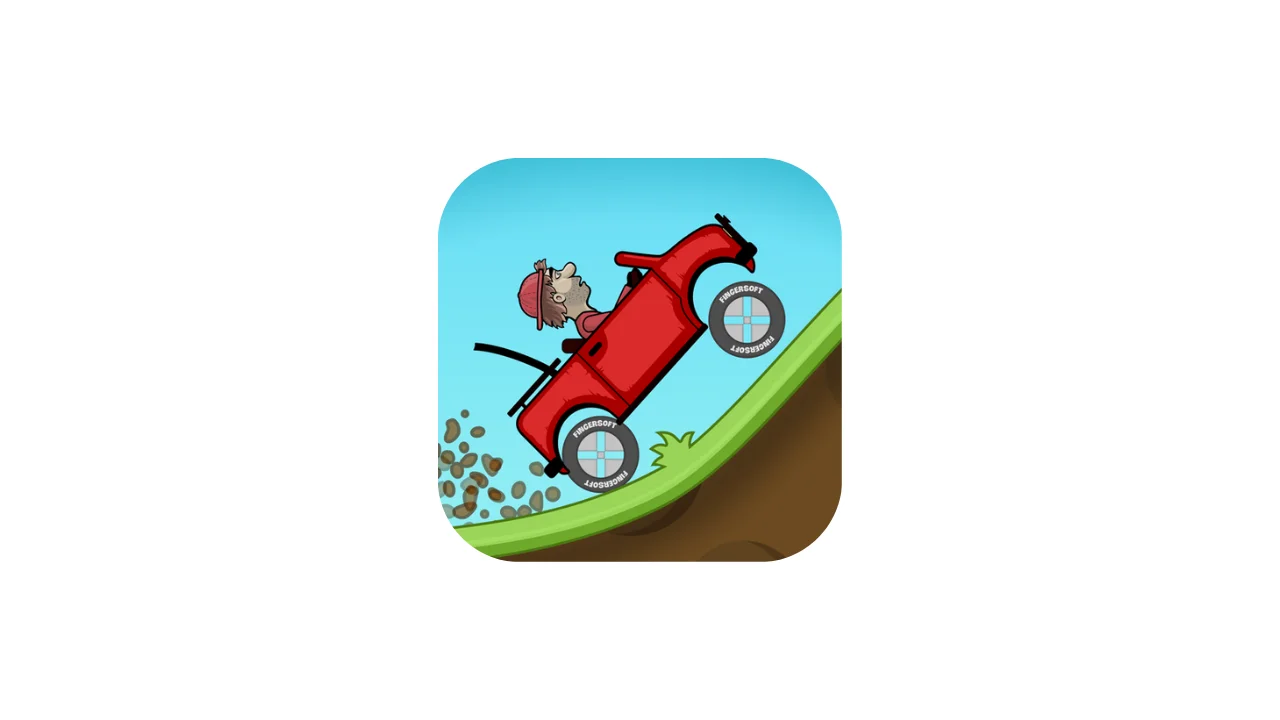
Hill Climb Racing is one of the most enduring mobile games ever made. Developed by Finnish studio Fingersoft and first released in 2012, it has accumulated over 1 billion downloads across Android and iOS — a milestone reached by only a handful of mobile games in history. More than a decade after launch, it remains in the top charts in multiple countries, a testament to how well its core loop holds up.
The concept is deceptively simple: drive a vehicle up procedurally generated hills, collect fuel and coins, avoid rolling over, go as far as possible. But underneath that simplicity lies a surprisingly deep physics system, a progression loop built around vehicle upgrades, and a roster of unlockable stages and cars that keeps players experimenting for hundreds of hours.
This guide covers the game in full — how the physics and controls actually work, what each upgrade does and which ones to prioritise, a breakdown of every vehicle category, stage-by-stage strategies, and tips for earning coins faster. Whether you just downloaded the game or you have been playing for years and want to push your distance records further, there is something here for you.
What Is Hill Climb Racing?
Hill Climb Racing is a 2D side-scrolling physics game. You control a vehicle driving from left to right across terrain that rises and falls unpredictably. Your goal is to travel as far as possible before running out of fuel or crashing — which in Hill Climb Racing means flipping your vehicle onto its roof.
The game is available free on Android (Google Play) and iOS (App Store). It includes optional in-app purchases for coins and premium currency, but all gameplay content can be unlocked through regular play without spending real money. An internet connection is not required — the game is fully playable offline.
Hill Climb Racing 2, the sequel, was released in 2016 and added multiplayer racing, cups, and seasonal events. The original Hill Climb Racing remains available and actively played alongside it. This guide covers the original game primarily, with notes on differences in the sequel where relevant.
The Physics System: Why This Game Feels Different
Most mobile driving games use simplified physics where the vehicle stays glued to the road. Hill Climb Racing does the opposite. Its physics engine simulates wheel traction, vehicle weight distribution, suspension compression, torque, and centre of gravity in real time. This is what gives the game its distinctive feel — and what makes mastering it genuinely rewarding.
Here is what that means in practice:
- Wheel traction: Each wheel gains and loses grip independently based on the surface angle and the vehicle’s speed. On loose or steep terrain, spinning your wheels too fast causes slipping rather than forward progress.
- Weight transfer: Accelerating hard shifts the vehicle’s weight toward the rear wheels, lifting the front and potentially causing a backward flip on steep climbs. Braking shifts weight forward, which can cause a nose-dive on downhill slopes.
- Suspension: The suspension compresses when a wheel hits a bump and rebounds when it clears it. On vehicles with soft suspension, this creates a bouncing effect that can be used to launch over obstacles — or that can cause you to lose control on rough terrain.
- Airborne behaviour: When all wheels leave the ground, the vehicle continues to rotate based on its angular momentum. Pressing the accelerator in the air rotates the vehicle nose-down (forward flip); pressing the brake rotates it nose-up (backward flip). This is the core skill of the game — using mid-air throttle and brake to land your vehicle wheels-first.
🏁 Pro Tip: The single most important skill in Hill Climb Racing is landing correctly after going airborne. Always aim to land rear wheels first on downhill slopes and front wheels first on uphill slopes. A perfectly timed brake tap before landing on a downhill can prevent a flip that would otherwise end your run.
Controls: Simple Inputs, Deep Execution
Hill Climb Racing uses only two inputs: a brake pedal on the left side of the screen and an accelerator pedal on the right. That is the entire control scheme. No steering, no gear changes, no camera control.
The simplicity is intentional. The challenge comes entirely from how and when you apply these two inputs, not from the complexity of the interface. Here is a more detailed breakdown of what each input does in different situations:
Accelerator (Right Pedal)
- On the ground: drives the vehicle forward. On rear-wheel-drive vehicles (most of them), it spins the rear wheels. On all-wheel-drive vehicles like the Jeep, it powers all four wheels.
- In the air: rotates the vehicle nose-down (forward lean). Useful for correcting a backward lean before landing on flat ground or a downhill slope.
- On a steep uphill: requires modulation — full throttle on very steep terrain often causes wheel spin and backward flipping. Feathering the throttle (tapping it repeatedly rather than holding it down) maintains traction.
Brake (Left Pedal)
- On the ground: decelerates the vehicle and can lock the wheels, causing a skid on loose surfaces.
- In the air: rotates the vehicle nose-up (backward lean). Essential for landing flat or rear-first on uphill slopes after a big jump.
- On a downhill: using the brake before reaching the bottom of a dip prevents the nose from slamming into the upslope on the other side, which often causes a flip.
🏁 Pro Tip: On the Moon stage — one of the most popular stages for distance records — the low gravity means you spend a huge proportion of time airborne. Players who master mid-air rotation using the brake and accelerator will travel dramatically further than those who do not.
Vehicle Roster: Every Category Explained
Hill Climb Racing features a large and diverse vehicle roster, each with different handling characteristics, strengths, and optimal stages. Here is a breakdown by category:
Starter Vehicles
- Hill Climber: The default vehicle and one of the most versatile in the game. Rear-wheel drive, moderate weight, and balanced suspension. Its relatively short wheelbase makes it agile on tight terrain. Most players’ distance records are set with the Hill Climber because its balance makes it forgiving across a wide range of stages.
- Jeep: Unlocked early and one of the few all-wheel-drive vehicles. More stable on loose or uneven surfaces than the Hill Climber, but heavier and slower to accelerate. Excellent on the Country Side and Arctic stages where traction matters more than speed.
High-Performance Vehicles
- Racing Car: Fast and low to the ground, with stiff suspension and high top speed. Excellent on smooth stages like the Highway, but difficult to control on rough terrain because its low ground clearance causes the chassis to scrape on obstacles. Upgrading the engine makes this one of the fastest vehicles in the game on appropriate stages.
- Sports Car: Similar profile to the Racing Car but with slightly more ground clearance. Better suited to mixed terrain than the Racing Car but still struggles on very rough stages. Popular for the Desert and Highway stages.
- Formula Car: The most aerodynamically extreme vehicle in the roster. Very fast but extremely sensitive to terrain irregularities. High-skill ceiling — in experienced hands it can set exceptional distance records on smooth stages, but beginners will find it frustrating.
Off-Road and Heavy Vehicles
- Truck: Heavy, powerful, and durable. Its large wheels and high ground clearance allow it to roll over obstacles that would stop lighter vehicles. Slower than performance vehicles but far more stable on rough or rocky terrain. Recommended for the Cave and Arctic stages.
- Monster Truck: Even larger and heavier than the Truck, with huge wheels that can climb over almost any obstacle. Very slow to accelerate and difficult to control at speed, but nearly impossible to flip on rough terrain. Useful for stages with large boulder-type obstacles.
- Tractor: Agricultural vehicle with enormous rear wheels and a very high top of centre of gravity. Notoriously easy to flip backward on steep climbs due to its weight distribution. Mastering the Tractor requires very precise throttle control, but its fans argue it is the most satisfying vehicle to drive well.
Novelty and Special Vehicles
- Motocross Bike: Two wheels only, which makes it far more susceptible to flipping than any four-wheeled vehicle. Very fast and can navigate tight terrain that four-wheeled vehicles struggle with. High risk, high reward — experienced players use it for speed-based challenges.
- Snow Mobile: Designed for the Winter and Arctic stages. Its track-based drive system provides exceptional traction on snow and ice. On other surfaces it is awkward and slow.
- Tank: Military vehicle with a tracked drive system. Extremely heavy, very slow, but almost impossible to flip. Can climb near-vertical surfaces that would defeat any wheeled vehicle. Its fuel consumption is high, making fuel management critical.
- Carantula: A fictional spider-car hybrid with six legs instead of wheels. Its unique locomotion system behaves differently from every other vehicle in the game — it can climb surfaces that wheeled vehicles cannot, but its movement is unpredictable. One of the most unusual vehicles in mobile gaming.
Stage Guide: Terrain, Challenges, and Best Vehicles
Hill Climb Racing features multiple unlockable stages, each with a distinct terrain type, obstacle set, and optimal vehicle choice. Here is a guide to the most important stages:
Country Side (Starting Stage)
The default stage and the one every player begins on. Rolling green hills with moderate inclines, a mix of smooth and bumpy surfaces, and scattered fuel canisters. The terrain is forgiving enough to learn the controls on but varied enough to remain interesting once you understand the physics.
Best vehicles: Hill Climber, Jeep. Avoid the Racing Car on Country Side — the terrain is too rough for its low suspension.
🏁 Pro Tip: Country Side is the best stage for grinding coins early in the game. The fuel canisters are positioned generously, allowing long runs without fuel upgrades. Focus on collecting every coin visible before worrying about distance.
Desert
Sand dunes replace the grass hills of Country Side. The terrain features longer, smoother slopes with occasional sharp drops. Sand provides slightly less traction than grass, which matters on the steeper inclines.
Best vehicles: Sports Car, Hill Climber, Jeep. The Desert’s longer slopes suit vehicles with good top speed. The lack of sharp obstacles makes it playable with lower-suspension vehicles.
Arctic
Ice and snow replace grass and sand. The critical difference is traction — ice provides far less grip than any other surface in the game, which fundamentally changes how you apply throttle. Spinning wheels on ice causes the vehicle to slide sideways rather than move forward.
Best vehicles: Snow Mobile (by far the best here), Jeep (all-wheel drive helps on ice), Truck (heavy enough to maintain momentum). Avoid rear-wheel-drive performance vehicles on the Arctic — wheel spin is almost unavoidable.
🏁 Pro Tip: On the Arctic stage, momentum management is more important than throttle control. Get up speed on flat sections and carry it through uphill climbs rather than trying to power up from a standstill, which causes wheel spin.
Moon
The Moon stage replaces Earth’s gravity with simulated lunar gravity — approximately one-sixth of normal. The result is that every bump launches you much higher and you spend far more time airborne than in any other stage.
The Moon stage has the highest skill ceiling of any stage in the game. Mid-air rotation control — using the brake and accelerator to orient the vehicle for landing — is not just helpful here; it is mandatory. Players who cannot control their vehicle in the air will not travel far.
Best vehicles: Hill Climber (manageable in low gravity), Motocross Bike (fast and its light weight suits low-gravity airborne physics). The Moon is one of the most popular stages for distance record attempts.
🏁 Pro Tip: On the Moon, landing gear-first on downhill slopes is even more important than on Earth stages because the lower gravity means a bad landing sends you flying further before you can recover. Always brake before landing on downhill terrain.
Cave
Underground stage with rocky, uneven terrain and low ceilings in some sections. The rocks are larger and more irregular than in other stages, making ground clearance a key factor. The Cave is one of the harder stages for vehicles without significant suspension or clearance upgrades.
Best vehicles: Truck, Monster Truck, Tank. Avoid low-clearance vehicles — the chassis will catch on rocks and stop your progress.
Highway
Smooth asphalt with long, gentle slopes. The Highway is the closest thing in Hill Climb Racing to a traditional racing game environment. There are fewer traction challenges, and the smooth surface allows high-speed vehicles to reach their maximum potential.
Best vehicles: Racing Car, Formula Car, Sports Car. This is the definitive stage for speed-focused vehicles. Upgrade your engine as high as possible before attempting distance records on the Highway.
The Upgrade System: What to Prioritise
Every vehicle in Hill Climb Racing can be upgraded across four core categories: Engine, Suspension, Tires, and All-Wheel Drive (where applicable). Each category has multiple upgrade tiers, and the cost increases significantly with each tier. Here is what each upgrade actually does and how to prioritise your spending:
Engine
Engine upgrades increase the torque and top speed of your vehicle. This is the most impactful upgrade for distance because more power means you can maintain speed over longer or steeper climbs without losing momentum.
Engine upgrades are the highest priority for most vehicles on most stages. The exception is stages where traction is the limiting factor (Arctic, Cave) — in those cases, tire and suspension upgrades matter more than raw power.
Suspension
Suspension upgrades change how the vehicle absorbs impacts from rough terrain. Softer suspension gives a smoother ride on very rough ground but can cause instability at high speed. Stiffer suspension is more stable at speed but transmits more of the terrain’s roughness to the chassis.
For the Hill Climber and Jeep on Country Side and Desert, moderate suspension upgrades (mid-tier) are the sweet spot. For off-road vehicles on the Cave or Arctic, prioritise suspension. For performance vehicles on the Highway, suspension upgrades matter less than engine and tires.
Tires
Tire upgrades increase the grip of your wheels on the terrain. This directly affects how effectively engine power translates to forward motion. On high-traction stages (Country Side, Desert), the difference between low and high tire upgrades is noticeable but not dramatic. On low-traction stages (Arctic, Cave rocks), tire upgrades are critical.
On the Moon, tire upgrades matter less because the reduced gravity means wheel spin is less of an issue — but they still improve landing stability.
Four-Wheel Drive
Available only on vehicles that support it (the Jeep and a few others). All-wheel drive sends engine power to all four wheels rather than just the rear two, which dramatically improves traction on slippery or uneven surfaces.
If you are primarily playing the Arctic or Cave stages on a compatible vehicle, upgrading to all-wheel drive is one of the most impactful single upgrades available.
Recommended Upgrade Order for Beginners
- Start with Engine upgrades (Tier 1 and 2) on your primary vehicle
- Then upgrade Tires to at least Tier 2 to match the increased engine power with better traction
- Add one or two Suspension upgrades to smooth out rough terrain
- Return to Engine for Tier 3 and 4 upgrades once the other systems are balanced
- Save the most expensive top-tier upgrades for vehicles you play most frequently
🏁 Pro Tip: Do not spread your coins across multiple vehicles early in the game. Pick one vehicle — the Hill Climber is the best choice for beginners — and max out its upgrades before moving to another. A fully upgraded Hill Climber will outperform a partially upgraded Racing Car in most situations.
Earning Coins Efficiently
Coins are the primary currency in Hill Climb Racing and are earned by collecting them during runs, completing missions, and watching optional rewarded ads. Here are the most effective strategies for earning coins faster:
Collect Every Coin During Runs
Coins appear scattered across the terrain throughout every stage. Some are on the ground level and collected automatically as you drive over them; others are positioned in the air above jumps and require you to time your trajectory to collect them. Learning the coin layout of your most-played stage allows you to plan your path to maximise collection.
Complete Daily Missions
Hill Climb Racing presents a set of missions that refresh periodically. These include objectives like ‘travel X distance,’ ‘collect X coins in one run,’ or ‘perform X backflips.’ Completing missions awards bonus coins significantly above what you would earn through normal runs. Check your missions before each session and play with them in mind.
Use the Magnet Power-Up
The Magnet power-up automatically attracts nearby coins to your vehicle without requiring precise positioning. When it activates, focus on distance and avoiding crashes rather than worrying about coin collection — the magnet handles it. Save magnet power-ups for long runs where coin density is high.
Perform Stunts
Backflips and front flips award bonus coins above the standard collection rate. On stages with big jumps, deliberately rotating your vehicle 360 degrees before landing adds up quickly over a long run. The Moon stage is particularly good for stunt bonuses because the low gravity gives you time to complete full rotations.
Hill Climb Racing 2: Key Differences
Hill Climb Racing 2 is the sequel, released in 2016 and updated continuously since. It shares the same physics foundation as the original but adds several major features:
- Multiplayer Cup races: real-time races against other players in asynchronous ghost-car format
- Seasonal events with limited-time rewards and exclusive vehicles
- A new coin system with gems as a premium currency
- Team-based features where players join groups and compete collectively
- A larger vehicle roster with more frequent additions through updates
The original game has a simpler, more relaxed feel — just you, your vehicle, and the hill. Hill Climb Racing 2 adds competitive and social dimensions that some players love and others find pressure-inducing. Both games are free and worth trying to see which suits your play style.
Frequently Asked Questions
Is Hill Climb Racing free to play?
Yes, Hill Climb Racing is free to download and play on both Android and iOS. It includes optional in-app purchases for coins and gems, but all vehicles, stages, and upgrades can be unlocked through regular gameplay without spending money. The free experience is complete and unlimited.
Can I play Hill Climb Racing without an internet connection?
Yes, Hill Climb Racing is fully playable offline. No internet connection is required for standard gameplay, stage completion, or vehicle upgrades. An internet connection is only needed to post scores to the online leaderboard or to watch optional rewarded ads for bonus coins.
What is the best vehicle for beginners?
The Hill Climber is the best starting vehicle for new players. It has balanced handling, forgiving suspension, and performs acceptably on every stage. It is also the vehicle with the most community knowledge around optimal upgrade paths and stage strategies. Once you understand the physics thoroughly, you can explore other vehicles with confidence.
How do I stop flipping over on steep hills?
Backward flips on steep uphills are caused by too much throttle, which transfers weight to the rear wheels and lifts the front wheels. The fix is to feather the throttle — tap it repeatedly rather than holding it down — on steep climbs. This maintains forward momentum without generating enough torque to flip. Suspension and tire upgrades also help by improving traction, which means you need less wheel spin to maintain speed.
What does the fuel upgrade do?
The fuel upgrade increases your starting fuel capacity, which directly limits how far you can travel in a single run regardless of your driving skill. Fuel canisters are scattered throughout each stage and refill your tank when you drive over them, but they are not always positioned conveniently. Upgrading fuel capacity is a high-value investment because it extends the ceiling of how far any single run can go.
Is Hill Climb Racing suitable for children?
Yes. Hill Climb Racing has a cartoon visual style, no violent content, and simple controls. It is rated E for Everyone on the Google Play Store and 4+ on the Apple App Store. The mild frustration of flipping your vehicle makes it engaging for adults as well, and many families play it together. The in-app purchases are real money, so younger players should have parental supervision around those prompts.
Final Verdict
Hill Climb Racing’s longevity is not accidental. Its physics engine creates a feedback loop that genuinely rewards skill development — the more precisely you understand how weight transfer, wheel traction, and airborne rotation work, the further you go. That progression from confused beginner to someone who instinctively knows when to feather the throttle and how to land a 50-metre jump on the Moon is what keeps players returning.
The upgrade system adds a satisfying meta-game layer: every coin you collect contributes to meaningful performance improvements that open new distance possibilities. The stage variety — from icy Arctic tundra to low-gravity Moon terrain — ensures that different playstyles and vehicle types all have their own optimal context.
It is not a perfect game. The later upgrade tiers are expensive enough that impatient players will feel pressure toward in-app purchases. And for players who want multiplayer or online competition, the original game’s offline-only leaderboard is a limitation — Hill Climb Racing 2 is the better choice for competitive play.
But as a single-player physics experience that is free, offline-capable, and genuinely deep despite its simple appearance, Hill Climb Racing remains one of the best mobile games ever made. If you have not played it, download it. If you have played it casually, this guide should give you the tools to push significantly further.