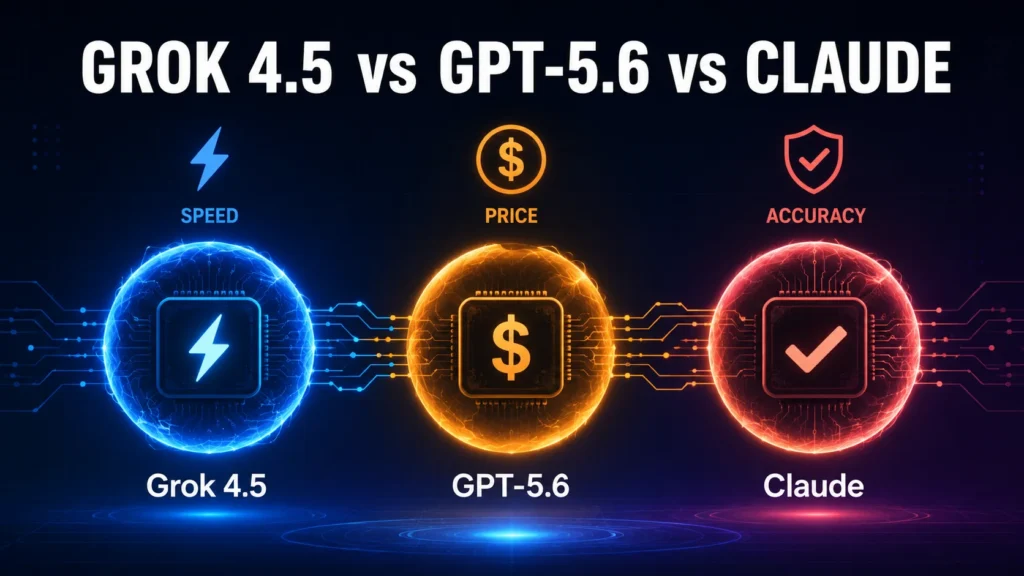
Three AI labs shipped new flagship models in the same nine-day window this July, and none of them agree on what “best” means. Grok 4.5 wins on price. GPT-5.6 Sol wins on raw coding and browsing benchmarks. Claude still wins on accuracy, with Claude Fable 5 topping every published coding test and Claude Sonnet 5 offering the best value inside the Claude lineup. Which one is right for you depends on whether you care more about cost, ceiling, or reliability.
We pulled the numbers straight from each company’s own launch pages, plus independent testing from Artificial Analysis and a few build-off comparisons that put all three models through the same prompts. Here’s what actually holds up.
Quick Answer: Which One Should You Pick?
If you’re paying by the token and running high volume, Grok 4.5 at $2 input / $6 output per million tokens is hard to beat. If you need the deepest reasoning on messy, large codebases and don’t mind paying for it, GPT-5.6 Sol or Claude Fable 5 are your two options. If you want the best balance of price and quality for everyday coding and writing work, Claude Sonnet 5 at $2 input / $10 output (through August 31) is the one most people should start with.
None of these is a universal winner. That’s the honest answer, and it’s also the more useful one.
What Actually Launched, and When
This matters more than usual because all three releases landed almost on top of each other.
- Grok 4.5 (xAI) shipped to developers on July 8 and to the public on July 9. It’s a 1.5 trillion-parameter model trained specifically for coding and agents, built in collaboration with Cursor using real debugging session data instead of static code repositories.
- GPT-5.6 (OpenAI) is not one model but a three-tier family: Sol (flagship), Terra (balanced), and Luna (fast, cheap). OpenAI announced it June 26 but held it in a limited preview coordinated with the US government, per a cybersecurity executive order requiring frontier labs to submit powerful models for review before public release. It went fully public July 9, the same week as Grok.
- Claude isn’t a single model right now either. Claude Sonnet 5 launched June 30 as Anthropic’s new default across every plan. Claude Opus 4.8 launched May 28 and remains the mid-premium option. Claude Fable 5, Anthropic’s top tier, actually launched in June, got suspended on June 12 under a US Commerce Department export control order, and was restored worldwide on July 1 once that order was lifted.
So when someone asks “Grok 4.5 vs GPT-5.6 vs Claude,” the honest first step is figuring out which Claude they mean. We’ll cover all three tiers below.
How Do They Compare on Price?
This is where Grok 4.5 makes its strongest case.
| Model | Input (per 1M tokens) | Output (per 1M tokens) | Context Window |
|---|---|---|---|
| Grok 4.5 | $2 | $6 | Not published at time of writing |
| GPT-5.6 Luna | $1 | $6 | 1.05M |
| GPT-5.6 Terra | $2.50 | $15 | 1.05M |
| GPT-5.6 Sol | $5 | $30 | 1.05M (128K max output) |
| Claude Sonnet 5 | $2 (intro, through Aug 31) → $3 | $10 (intro) → $15 | 1M |
| Claude Opus 4.8 | $5 | $25 | 1M (128K max output) |
| Claude Fable 5 | $10 | $50 | 1M |
Grok 4.5’s output pricing matches GPT-5.6 Luna and comes in at roughly a fifth of GPT-5.6 Sol and about an eighth of Claude Fable 5. That’s a real advantage for high-volume agentic workloads, where every completed task fires off dozens of model calls.
But cost per token isn’t the same as cost per finished task. xAI’s own numbers show Grok 4.5 used about 15,954 output tokens on its published SWE-Bench Pro run, versus 67,020 for Claude Opus 4.8 at max effort. Independent testing found a completed agentic coding task cost $2.49 on Grok versus $11.80 for Fable 5 running inside Claude Code. That’s a genuinely wide gap, and it’s the strongest argument xAI has.
Which One Codes Better?
Short answer: it depends on the benchmark, and none of these labs win everything.
On SWE-Bench Pro, a benchmark that runs against live repositories with no leaked answers:
- Claude Fable 5: 80.4%
- Claude Opus 4.8: 69.2%
- Grok 4.5: 64.7%
- GPT-5.5 (the model GPT-5.6 replaces): 58.6%
On DeepSWE 1.1, which scores how reliably a model closes real developer-submitted bugs:
- Claude Fable 5: 70%
- GPT-5.5: 67%
- Claude Opus 4.8: 59%
- Grok 4.5: 53%
On Terminal-Bench 2.1, GPT-5.6 Sol pulls ahead with 91.9%, using a new “ultra mode” that splits work across parallel subagents. That’s the one test where OpenAI’s newest release genuinely leads the field, and it’s a fair win.
We also found a real-world build-off worth mentioning. A team at TryAI gave Grok 4.5, GPT-5.5, Claude Opus 4.8, and Claude Fable 5 the same one-shot prompts to build small interactive apps. On a Rubik’s cube simulator, Opus 4.8 and Fable 5 both nailed it first try. Grok 4.5 needed a retry. GPT-5.5 rendered a single flat face with no cube at all. On a calculator app, both Claude models nailed all five attempts across a wider follow-up test, while GPT-5.6 tried to over-style the interface and ended up with a worse result than a plain calculator should have.
None of this means Claude wins everything either. In the same expanded test, GPT outperformed every model on a first-person 3D raycaster, and Claude’s results there were weaker than expected. The pattern that keeps showing up: Claude models are the most consistent across varied tasks, GPT-5.6 Sol has the strongest ceiling on hard reasoning and terminal work, and Grok 4.5 is competitive but not dominant on raw scores, with cost as its real selling point.
Independent Testing Tells a Slightly Different Story
Vendor benchmarks are self-reported, so it’s worth checking outside numbers. Artificial Analysis, which runs its own evaluation suite across 168 models, ranks Grok 4.5 fourth on its Intelligence Index, behind Fable 5, GPT-5.6 Sol, and one other model. The same testing flagged something concerning: Grok’s hallucination rate jumped from 25% to 54% on one knowledge measure as the model got more confident while being wrong. That’s a real trade-off worth knowing about before you route anything customer-facing through it.
Cursor’s CEO Michael Truell, whose company helped train Grok 4.5, said it has become “the daily driver for many on our team,” which carries weight given Cursor’s stake in the outcome. Musk positioned Grok 4.5 as roughly comparable to Opus 4.7, one generation behind Anthropic’s current top tier, faster and cheaper rather than smarter.
Availability: Where Can You Actually Use Each One?
This part gets skipped a lot, and it shouldn’t.
- Grok 4.5 is live in Grok Build, in Cursor on all plans, and in the SpaceXAI console. It is not yet available in the EU.
- GPT-5.6 is rolling out through the API, Codex, and ChatGPT, following its government-gated preview. OpenAI CEO Sam Altman has said the company doesn’t see gated rollouts as sustainable for future releases.
- Claude Sonnet 5, Opus 4.8, and Fable 5 are all available through Claude’s apps, the Claude Platform, and through AWS, Google Cloud, and Microsoft Foundry. Fable 5’s brief suspension in June was a compliance event tied to export controls, not a product problem, and access was fully restored globally by July 1.
If you’re in the EU and specifically want Grok 4.5, that’s currently a blocker worth knowing before you build a workflow around it.
Which Model Should You Actually Use?
Match the model to the job, not the headline.
- High-volume coding agents where cost per run matters most → Grok 4.5. The token efficiency and low per-task cost are real, even if raw accuracy trails the two premium options.
- Deep reasoning across large, messy codebases, or long terminal sessions → GPT-5.6 Sol. Its subagent-based ultra mode is built for exactly this.
- Everyday coding, writing, and agent work where you want strong quality without premium pricing → Claude Sonnet 5. At introductory pricing through August 31, it’s priced close to Grok while landing much closer to Opus-level output on many tasks.
- The hardest problems, where a failed agent run costs more than the extra tokens → Claude Fable 5. It’s the most expensive model here by a wide margin, but it also leads every published coding benchmark in this comparison.
If you only remember one thing from this article, remember this: the model that wins on a benchmark chart is rarely the model that wins your actual budget. Check both before you commit a workflow to any of these.
Frequently Asked Questions
Is Grok 4.5 really “Opus-class” like Elon Musk claims? Not quite. Grok 4.5 loses to Claude Fable 5 on every published benchmark in its own launch chart and to Claude Opus 4.8 on two of four. It’s competitive, especially on cost, but it’s a generation behind Anthropic’s current top-tier model on raw accuracy.
Why does GPT-5.6 come in three versions? OpenAI split it into Sol, Terra, and Luna to cover different budgets. Sol is the flagship for hard reasoning and coding. Terra is the balanced production tier. Luna is the fastest and cheapest, aimed at high-volume work where Sol would be overkill.
Why was Claude Fable 5 unavailable for a few weeks? Anthropic suspended access to Fable 5 and Mythos 5 on June 12 to comply with a US Commerce Department export control order. The Commerce Department lifted those controls on June 30, and Anthropic restored global access on July 1.
Is Claude Sonnet 5 as good as Claude Opus 4.8? Not across the board, but it’s close on several tasks and priced well below it. Anthropic’s own cost-performance charts show Sonnet 5 matching Opus 4.8’s capability level in some scenarios, particularly at higher effort settings, while costing less than half as much per token at standard rates.
Which model is cheapest for high-volume use? Grok 4.5 and GPT-5.6 Luna are tied on output price at $6 per million tokens, with Luna slightly cheaper on input at $1 versus Grok’s $2. Both are far cheaper than any premium tier from any of the three labs.
Can I use Grok 4.5 in the European Union right now? No, not yet. xAI has not made Grok 4.5 available in the EU as of this comparison. GPT-5.6 and all three Claude tiers do not have that restriction.