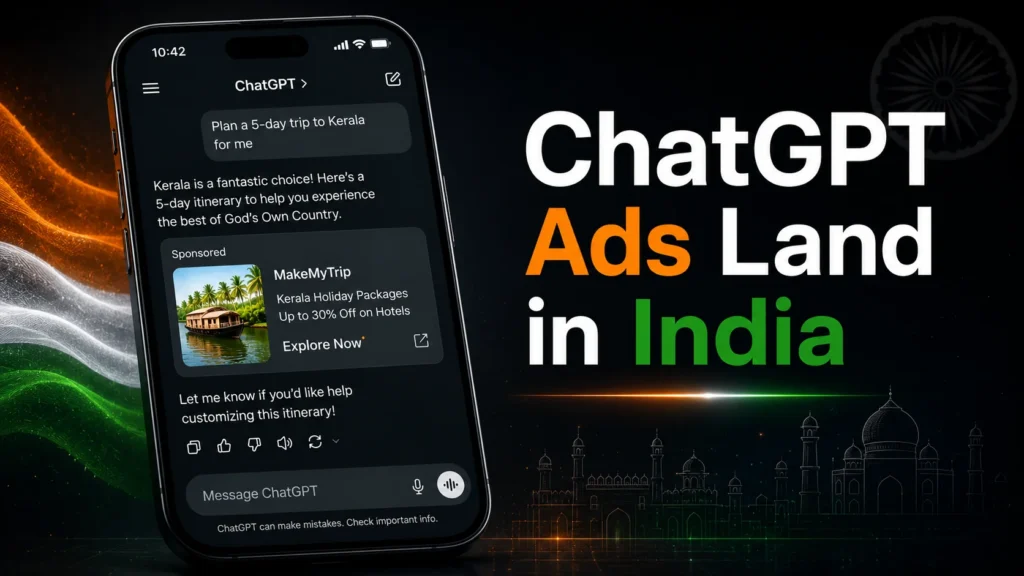
Open ChatGPT on your phone in India this week and you might notice something new at the bottom of an answer: a small “Sponsored” tag. That’s not a bug. OpenAI turned on ads for Free and Go users in India on August 27, 2026, and more than 50 brands are going live with campaigns in the days that follow.
I’ll be honest — I didn’t expect this to happen in India this fast. The US test only started earlier this year, and India usually gets these rollouts months later, if at all. Not this time.
What Is Actually Changing in ChatGPT India
If you’re on ChatGPT’s Free plan or the Go plan (Rs 399/month), you’ll start seeing labelled ads at the bottom of some responses. The ads stay separate from ChatGPT’s actual answers and appear as clearly labelled, visually distinct content rather than being woven into the response text.
If you’re paying for Plus, Pro, Business, Enterprise, or Education, nothing changes for you. Those tiers remain ad-free.
So the honest answer to “will ChatGPT ads affect my chats” is: only if you’re on the free or Go tier, and only as a tag under certain answers — not inside the conversation itself, at least for now.
Why India, and Why Now
India isn’t a side market for OpenAI. It’s one of the company’s largest markets, and India remains ChatGPT’s second-largest market globally, with over 100 million weekly users as of February 2026. ChatGPT crossed 1 billion weekly users worldwide earlier this month. That’s a lot of free-tier traffic sitting on top of a business that’s still spending far more than it earns.
OpenAI confidentially filed for an IPO in June 2026, and its revenue reached $6.7 billion in the June quarter, up from $5.7 billion — while its operating loss widened to $12.3 billion from $9.3 billion. Ads are one of the few obvious ways to close that gap without raising subscription prices. Framed that way, this isn’t really an India story. India is just where the math gets tested at scale next.
There’s also a personal irony here. Sam Altman spent 2024 describing advertising in ChatGPT as a “last resort,” worried it would erode user trust. Eighteen months later, that “last resort” is the plan.
Who’s Actually Running the Ads
WPP and Omnicom are OpenAI’s first agency partners in India, handling everything from strategy and creative to measurement and brand safety. Over 50 brands are expected to go live with campaigns this week, and OpenAI plans to open self-serve access to ChatGPT Ads Manager on September 4, with daily budgets starting at Rs 725.
That self-serve detail matters more than it looks. Rs 725 a day is genuinely low — closer to a small local shop’s Instagram ad budget than a big-brand TV spend. Once that door opens, expect a flood of smaller Indian advertisers, not just the initial 50.
Where the Ads Actually Show Up
Instead of traditional banner ads, users see clearly labeled “Sponsored” cards or conversational product suggestions worked into relevant chats — for example, ask about travel plans and you might get a sponsored hotel suggestion. The sponsored products or services appear at the bottom of ChatGPT’s responses.
That’s a meaningfully different design than a banner ad you can just scroll past. It’s attached to the thing you asked about. Whether that stays “clearly separate” in practice, or starts to blur, is the thing worth watching over the next few months — not just taking OpenAI’s word for it.
What Happens to Your Data
This is the part most people actually care about, and it’s where OpenAI has been the most specific.
Advertisers cannot access users’ chats, chat history, memories, or personal details, and OpenAI says it does not sell user data to advertisers. Instead, advertisers get aggregate campaign-performance numbers — impressions and clicks — not access to individual conversations.
There are also some real guardrails around who sees ads at all. Ads won’t be shown to accounts belonging to users who identify themselves, or are predicted to be, under 18, and ads won’t be eligible alongside sensitive or regulated topics including mental health and politics.
Fair enough on paper. But “we promise not to use your data for targeting” is a claim, not an audit. This is exactly the kind of promise that U.S. lawmakers have already pushed back on. Senator Ed Markey wrote to Sam Altman in January 2026 raising consumer protection, privacy, and youth-safety concerns about advertising inside ChatGPT, warning that ads embedded in an emotionally-trusted chatbot could be used to manipulate users in ways a normal banner ad can’t. Those concerns don’t disappear just because the rollout moved to India.
Worth noting too — OpenAI isn’t alone here, and it isn’t even first. Microsoft has run contextual ads in Copilot since 2023, Perplexity has been testing ads in the US since 2024, and Google is testing ads inside its AI Overviews. Anthropic, notably, has stayed out of this — and even ran a Super Bowl ad mocking the idea of an AI chatbot slipping ad copy into its advice, which Altman called “clearly dishonest.” That back-and-forth tells you the industry itself is split on whether this is a smart move or a trust problem waiting to happen.
Does This Actually Work for Advertisers?
Early signs say yes, at least on conversion. Newegg reported that visitors referred from ChatGPT were more likely to convert and make a purchase compared with traffic from other channels, and the retailer is now testing conversion-optimised cost-per-click campaigns to build on that.
That’s the pitch brands are buying into: people asking ChatGPT for a recommendation are often closer to actually buying something than someone idly scrolling Instagram. Whether that conversion advantage survives once every category is flooded with sponsored suggestions is the open question.
How to Avoid Seeing Ads on ChatGPT in India
If you’d rather not deal with any of this, the fix is simple: upgrade off the Free or Go plan. Plus, Pro, Business, Enterprise, and Education users stay ad-free. There’s no in-app toggle to switch ads off while staying on a free tier — the ad-free experience is tied directly to which plan you’re on.
If you’re on Go specifically, at Rs 399 a month it’s already the cheapest paid tier, so it’s worth deciding now whether ad-free is worth that jump from free.
The Bigger Picture
Free AI access in India has been expanding fast this year through telecom bundling — Perplexity partnered with Airtel and Google partnered with Reliance Jio to offer extended free access, both drawing scrutiny from Indian regulators and analysts over what that “free” access is really funding. Ads are the next, more direct version of the same trade: free chatbot access, paid for by your attention and, eventually, your data.
I don’t think this rollout is dishonest or predatory on its own — the guardrails OpenAI describes are real and more specific than most companies bother with. But “trust us” is doing a lot of work here, and the Markey letter and the Anthropic ad both point at the same worry: an AI you talk to like a person is a very different advertising surface than a search results page. That difference is worth staying skeptical about, even while the ads themselves stay clearly labelled for now.
FAQ SECTION:
Q1: When did ChatGPT ads launch in India? A1: OpenAI announced the India rollout on August 27, 2026, with ads going live for Free and Go tier users and more than 50 brands launching campaigns that same week.
Q2: Will I see ads if I pay for ChatGPT Plus in India? A2: No. Plus, Pro, Business, Enterprise, and Education subscribers remain completely ad-free. Only Free and Go tier users see sponsored content.
Q3: Can advertisers see my ChatGPT conversations? A3: OpenAI says advertisers cannot access your chats, chat history, memories, or personal details, and that it does not sell user data. Advertisers only get aggregate metrics like impressions and clicks.
Q4: How much does ChatGPT Go cost in India, and does it include ads? A4: ChatGPT Go costs Rs 399 per month in India. It’s a paid tier but still shows ads, since only Plus and higher plans are ad-free.
Q5: Will ChatGPT ads change the actual answers I get? A5: OpenAI states that ads appear separately below responses and don’t influence or get woven into ChatGPT’s actual answers. Ads are labelled “Sponsored” and kept visually distinct.
Q6: Can businesses run their own ads on ChatGPT in India? A6: Yes. OpenAI is opening self-serve access to ChatGPT Ads Manager in India on September 4, 2026, with daily budgets starting from Rs 725, on top of the initial agency-led cohort running through WPP and Omnicom.