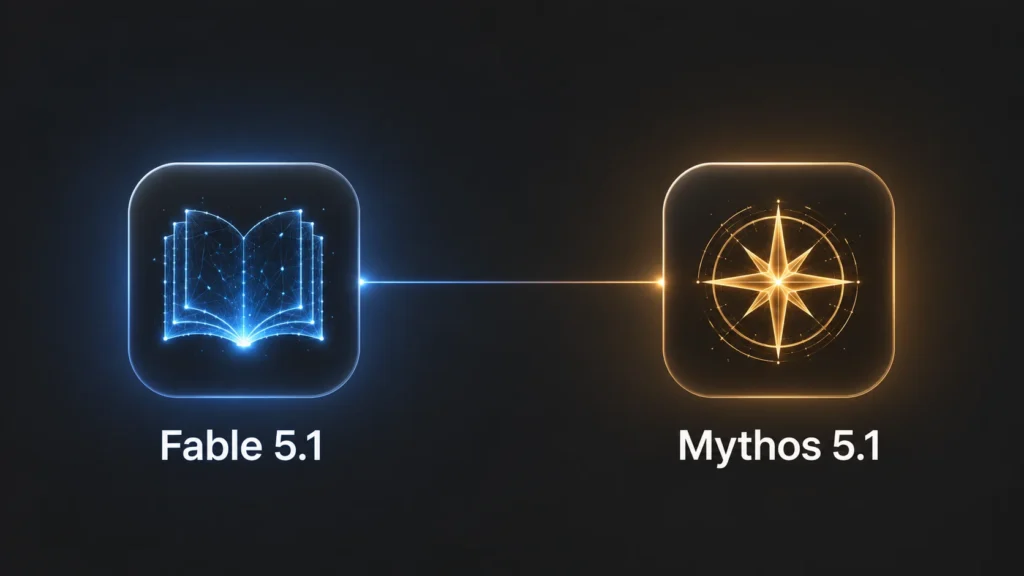
Anthropic released two new models on September 1, 2026, and only one of them is for you. Claude Fable 5.1 is live right now for anyone with a paid Claude plan or API account. Claude Mythos 5.1 is the same model underneath, running with fewer restrictions, and it’s locked behind a vetting process most people will never go through. Here’s what actually changed, what it costs, and whether switching is worth your time.
What is Claude Fable 5.1?
Claude Fable 5.1 is Anthropic’s updated Mythos-class model for coding, long-running agent work, and research tasks. It replaces Fable 5, which launched back on June 9, 2026, and it’s built for the kind of job that used to need constant babysitting — a multi-hour coding run, a messy research question, a task with no clean stopping point.
The headline change isn’t raw intelligence. It’s that Fable 5.1 stays coherent for longer. Anthropic says it “remains readable over long, multi-step tasks,” and that shows up in the customer quotes scattered through the launch materials — engineers describing 38-hour unattended runs and three-day prototype builds that didn’t fall apart halfway through.
What is Claude Mythos 5.1, and why can’t I use it?
Mythos 5.1 is Fable 5.1 with the safety guardrails turned down, not a smarter model. Anthropic is blunt about this: Fable 5.1 and Mythos 5.1 are the same model with different levels of safeguards. Mythos exists for two groups whose work legitimately runs into Fable’s restrictions — cybersecurity defenders and life sciences researchers.
You get to Mythos through one of two programs:
- Cyber Verification Program (CVP) — for vetted security teams doing defensive work like penetration testing and exploit research
- Life Sciences Verification Program (LSVP) — built with the US government, currently limited to a small set of US organizations, with international access planned later
If you’re not already inside one of those programs, you’re using Fable 5.1. That’s not a downgrade for almost anyone — it’s the version everyone should actually want.
How much does Claude Fable 5.1 cost?
Token pricing hasn’t moved: $10 per million input tokens, $50 per million output tokens, identical to Fable 5. The real change is buried in the cache pricing. Cache reads — where the model reuses context it already processed — dropped 75%, from $1 to $0.25 per million tokens.
That one line item matters more than it sounds. For a typical workload, Anthropic says total cost drops around 25%. For heavily agentic work — long coding sessions where the model keeps referencing the same growing context — the savings can hit 45%. If you’re running Claude Code sessions that stretch for hours, this is the number to actually watch, not the headline per-token price.
| Spec | Claude Fable 5.1 | Claude Mythos 5.1 |
|---|---|---|
| Availability | General — paid Claude, API, Bedrock, Google Cloud, Microsoft Foundry | CVP and LSVP only |
| Context window | 1 million tokens | 1 million tokens |
| Max output | 128,000 tokens | 128,000 tokens |
| Input pricing | $10 / million tokens | Same |
| Output pricing | $50 / million tokens | Same |
| Cache read pricing | $0.25 / million tokens (was $1) | Same |
| API model ID | claude-fable-5-1 | Restricted access |
| Thinking | Adaptive, always on | Adaptive, always on |
Is Fable 5.1 actually better than Fable 5 and Opus 5?
Yes, and the gap is bigger on longer, messier tasks than on quick one-shot questions. On Terminal-Bench-Science 0.1 — an agentic research benchmark — Fable 5.1 scored 52.6%, more than double Fable 5’s 24.7% and well ahead of Opus 5’s 29.0%. On Terminal-Bench 4.0, a coding benchmark, it hit 55.8% (Mythos 5.1 reached 60.9%, with the gap attributed mostly to safeguard interventions on Fable’s side).
A few numbers that matter for day-to-day work:
- AutomationBench (business workflows): 31.4% vs Fable 5’s 17.1%
- CursorBench 3.2.0 (agentic coding): 73.4% vs 70.5%
- Humanity’s Last Exam (no tools): 60.9% vs 57.8%
Millennium, the investment firm, said Fable 5.1 found the root cause of a crash in its systems that had gone unexplained for four to five years — including by earlier Claude models. That’s the kind of anecdote that’s easy to dismiss as marketing, except Anthropic published the specifics (disassembling an external vendor library, matching it against a core dump) rather than a vague “it’s smarter” claim.
What changed in the safeguards?
This is the part most coverage is skipping, and it’s the part that actually affects how the model feels to use. Anthropic rebuilt its cyber and biology safeguards to fire less often on benign requests. Claude Code users should see around 60% fewer safeguard interventions per session compared to Fable 5. Biology-related false positives on elementary and medical questions dropped by roughly 85%.
Fable 5.1 can now also be used to find software vulnerabilities — defensive security work — something the previous safeguards blocked outright. It still won’t help write exploits, run penetration tests, or do binary-based vulnerability scanning; those get redirected to Opus-class models.
There’s also a quieter change worth knowing about: anti-distillation protections. Starting with new API accounts created from launch day forward, you can no longer manually edit Claude’s prior context in a multi-turn conversation while keeping its earlier thinking intact. This closes a known technique people used to extract Claude’s reasoning process and train competing models on it. Existing accounts aren’t affected yet, but expect this to become standard with future releases.
Did Claude Fable 5.1 get suspended like the last version?
No — that was a different situation entirely, and it’s worth clearing up since it’s a common search right now. Fable 5 and Mythos 5 (the previous generation) were briefly pulled from access in mid-June 2026 to comply with US Department of Commerce export controls, then restored on July 1, 2026, once those controls were lifted. Fable 5.1 and Mythos 5.1 launched fresh on September 1, 2026, with no export-control issue attached. Different event, different models, three months apart.
What about the EU AI Act watermark?
Both models carry an invisible watermark on their outputs, required under the EU AI Act’s Code of Practice, which Anthropic signed alongside 190 other companies in July 2026. It doesn’t change what the model writes and it doesn’t contain any information about you or your conversations — it’s purely a detection signal. Right now, the detection API that reads the watermark is in private preview, limited to regulators, media, fact-checkers, researchers, and EU civil society groups. If you’re not in one of those categories, you can’t currently check whether a piece of text was watermarked, even though the watermark itself is already live.
Should you switch from Fable 5 to Fable 5.1?
For almost anyone running agentic coding, research, or long knowledge-work tasks, yes. The combination of better long-horizon coherence, a real cost cut on cache-heavy workloads, and fewer safeguard interruptions makes this an easy switch rather than a cautious one. The exception is if you’re deep into a workflow tuned around Fable 5’s specific quirks — in that case, test on a subset of tasks before moving everything over, since effort defaults changed too (Claude Code now defaults to High effort, while Claude Cowork and Claude.ai default to Medium).
If your work touches penetration testing, exploit research, or life sciences R&D, Fable 5.1’s safeguards will still redirect you — Mythos 5.1 access through the CVP or LSVP is the only way around that, and neither program is a quick sign-up.
FAQ SECTION:
Q1: What’s the actual difference between Claude Fable 5.1 and Claude Mythos 5.1? A1: They’re the same underlying model. Fable 5.1 runs with Anthropic’s standard production safeguards and is open to any paid Claude or API user. Mythos 5.1 runs with reduced safeguards for cybersecurity and life sciences work, and it’s only available through two vetted access programs.
Q2: How do I get access to Claude Mythos 5.1? A2: Apply through the Cyber Verification Program for defensive security work, or the Life Sciences Verification Program for biology and medical research. Both are limited-access programs built with vetted organizations, not open sign-ups — the LSVP is currently US-only.
Q3: Is Claude Fable 5.1 more expensive than Fable 5? A3: No, per-token pricing is identical at $10 input / $50 output per million tokens. Cache read pricing dropped 75%, which cuts total cost by roughly 25% for typical workloads and up to 45% for heavily agentic ones.
Q4: Is Claude Fable 5.1 the model that got pulled from access in June 2026? A4: No. That suspension affected the earlier Fable 5 and Mythos 5 models due to US export controls, and access was restored July 1, 2026. Fable 5.1 and Mythos 5.1 launched separately on September 1, 2026, with no export-control complications.
Q5: Does Claude Fable 5.1 beat Claude Opus 5? A5: On most benchmarks Anthropic published, yes — notably on Terminal-Bench-Science 0.1 (52.6% vs 29.0%) and AutomationBench (31.4% vs 26.9%). Opus 5 still has its place for workloads where Fable’s safeguards redirect certain cybersecurity or biology tasks.
Q6: What is the anti-distillation change in Fable 5.1? A6: New API accounts can no longer manually edit Claude’s earlier context in a conversation while keeping its prior reasoning intact. This blocks a known method for extracting Claude’s internal reasoning to train other models. Existing accounts aren’t affected yet.