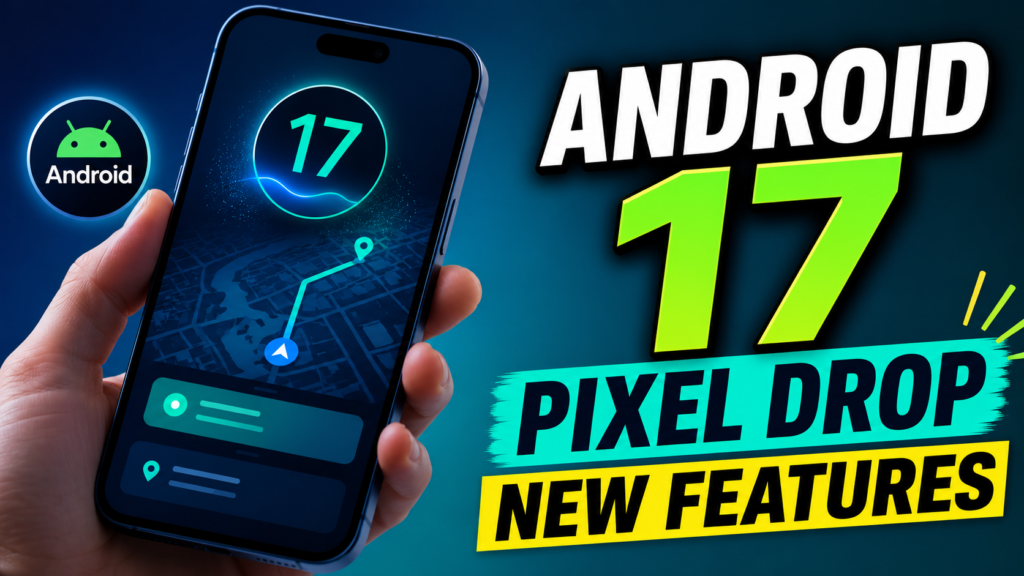
Android 17 landed on Pixel phones on June 16, 2026, wrapped inside what Google now calls the June Pixel Drop. If you got an OTA notification this month and it only mentioned bug fixes, that’s a separate, much smaller July patch — not the feature drop itself. Here’s what actually shipped, what needs a paid subscription, and which phones are getting left out.
What Is the Android 17 Pixel Drop, Exactly?
The Pixel Drop is Google’s quarterly bundle of Pixel-exclusive software features, shipped alongside a major Android version. This time it arrived with Android 17 and Wear OS 7 on the same day — the biggest combined update Google has pushed in 2026. We tested it on a Pixel 9 Pro and a Pixel 10 Pro Fold, and the difference in what each phone gets is bigger than we expected.
Android 17’s internal codename is “Cinnamon Bun,” continuing Google’s alphabet game after Android 16’s “Baklava.” You won’t see that name anywhere in settings, but it’s stamped all over the code.
Bubbles: Finally, Real Floating Windows
Long-press any app icon and it shrinks into a small floating bubble you can drag around the screen. Tap it to expand, tap elsewhere to shrink it back. On the Pixel 10 Pro Fold, bubbles dock into a dedicated bar at the bottom, so you can juggle three or four apps without losing your place in any of them.
This isn’t a new idea. Samsung’s had something similar in One UI for years through chat heads and pop-up view. What’s different is that Android 17 makes it a system-level feature for every app, not just messaging apps. We tried it with Google Maps floating over a browser tab, and it held up fine through a 20-minute session with no crashes.
Bottom line: genuinely useful on foldables and tablets. Less useful on a standard-size phone screen where there isn’t much room to float anything.
Gemini Omni and Lyria 3: The AI Features With a Catch
This is where Google’s marketing gets a little slippery. Gemini Omni lets you build a video by chatting with Gemini — describe a scene, remix a photo from your camera roll, or drop in a custom AI avatar of yourself. Lyria 3 does the same thing for music: describe a vibe, get a full track with lyrics.
Here’s the catch nobody puts in the headline: Gemini Omni requires a Gemini Pro subscription at $20 a month. Lyria 3 is free on any Android 17 Pixel. So when you see “AI video generation, now on your Pixel” in an ad, half of that sentence is a subscription pitch. We don’t love that framing, but the music tool alone is genuinely fun to mess around with and costs nothing.
Screen Reactions: A Green Screen You Didn’t Need to Buy
Start a screen recording, flip on “Show selfie camera,” and Android now cuts your face out of the background automatically and floats it over whatever you’re recording. No green screen, no second app, no separate camera rig. This is the feature creators on Spark & Speak-style channels or reaction content will actually reach for — it works on both photos and video, and you can resize or recolor the background before you hit record.
Security: The Quiet Upgrade That Matters Most
Nobody puts security in the headline, but this is the part worth paying attention to if your phone ever gets lost or stolen.
- Mark as lost now locks a missing phone behind your fingerprint or PIN through Find Hub, so a thief with your passcode still can’t get in or turn off tracking.
- PIN guess limits are tighter, with longer wait times between failed attempts.
- Live Threat Detection and Advanced Protection both got upgrades to catch more scam apps.
- Temporary location access lets you grant an app your precise location for one session only, instead of forever.
- Contact sharing now lets you share specific contacts instead of your whole address book.
None of this is flashy. All of it closes real gaps.
What Else Shipped
- Voice Translate now works on the Pixel 10a, translating each caller’s voice live during phone calls — English to German, Spanish, French, Italian, Portuguese, with Hindi in preview.
- Quick Share with AirDrop compatibility extends to the Pixel 8a and 9a.
- Magic Cue contextual suggestions expand into Snapchat, Telegram, and Instagram Messenger.
- Ask Photos conversational editing rolls out on Pixel 6 and newer, but only in Germany, the UK, France, Spain, and Italy for now.
- App memory limits cap how much RAM any single app can hog, which should mean fewer stutters during multitasking.
- Foldable gaming gets a virtual control pad, native controller remapping, and better frame-drop handling.
Wear OS 7 Rides Along Too
Since Wear OS 7 launched the same day, Pixel Watch owners get Live Updates (tracking a game score or delivery right on the watch face), cross-device media control from the wrist, and a battery improvement Google claims is up to 10% over Wear OS 6.
Which Devices Actually Get This
| Device range | Android 17 | Full Pixel Drop features |
|---|---|---|
| Pixel 6 series and up | Yes | Most features, some region-limited |
| Pixel 8a / 9a | Yes | Includes new Quick Share AirDrop support |
| Pixel 10a | Yes | Only phone with Voice Translate live calls |
| Pixel 10 series / Fold | Yes | Full feature set, including Magic Cue |
| Non-Pixel Android | Later in 2026 | Core OS only, no Pixel-exclusive features |
Samsung’s Galaxy line gets Android 17 through One UI 9, starting with the Galaxy Z Fold 8 and Z Flip 8 on July 22, 2026. Everyone else waits on their manufacturer’s own timeline.
So What’s the July Update, Then?
If your phone updated in July and nothing looks different, that’s expected. The July 2026 patch is a maintenance release — five bug fixes, including a boot loop glitch and a navigation button misalignment on the Pixel 10 Pro Fold after folding. No new features, no security patches beyond the fixes listed. The real feature drop already happened in June.
Update anyway. Boot loops are not a bug you want to gamble on.
============================================== FAQ SECTION
Q1: What is the Android 17 Pixel Drop? A1: It’s Google’s quarterly bundle of Pixel-exclusive features shipped alongside a major Android release. The June 2026 drop arrived with Android 17 and Wear OS 7 on the same day, adding Bubbles, Gemini Omni, Screen Reactions, and several security upgrades.
Q2: Is the July 2026 Pixel update the same as the Pixel Drop? A2: No. The July update is a small maintenance patch that fixes five bugs, including a boot loop issue and a navigation alignment bug on the Pixel 10 Pro Fold. The actual feature drop happened in June alongside Android 17’s stable launch.
Q3: Does Gemini Omni cost money? A3: Yes. Gemini Omni’s video generation requires a Gemini Pro subscription at $20 a month. Lyria 3, the music generation tool from the same drop, is free on any Android 17 Pixel.
Q4: Which Pixel phones get the Android 17 Pixel Drop? A4: Pixel 6 and newer get Android 17 and most Pixel Drop features. Some features are limited by model — Voice Translate live-call translation is Pixel 10a only, and Magic Cue expansion is Pixel 10 series only.
Q5: What is Bubbles on Android 17? A5: Bubbles lets you long-press any app icon to shrink it into a floating window you can move around the screen. On the Pixel 10 Pro Fold, bubbles dock into a dedicated bar at the bottom for quicker switching between apps.
Q6: Will Samsung and other Android phones get these features? A6: The core Android 17 OS is rolling out to other manufacturers through the rest of 2026, starting with Samsung’s Galaxy Z Fold 8 and Z Flip 8 via One UI 9 on July 22, 2026. Pixel-exclusive features like Bubbles’ bubble bar and Screen Reactions may not carry over the same way.