
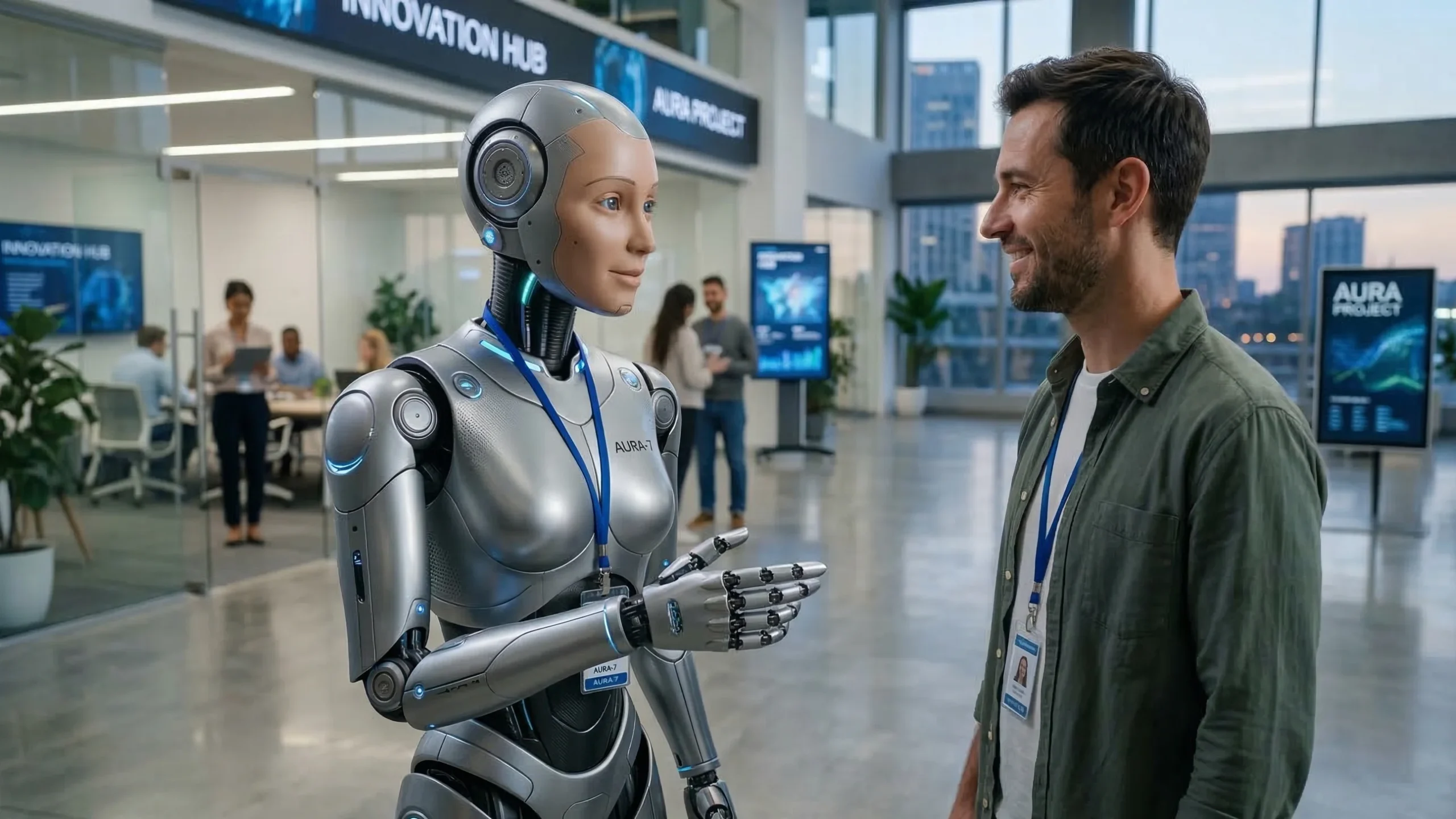
Humanoid robots are no longer just a thing from movies. They are real. They are working. And they are getting better every single year. If you have seen videos of robots walking across a factory floor or climbing stairs without falling, you already know what we are talking about.
But what exactly is a humanoid robot? In simple terms, it is a robot that is built to look and move like a human. It has a head, a body, two arms, and two legs. It can walk, carry things, use tools, and sometimes even hold a conversation. That is a huge deal for science and for everyday life.
In this article, we are going to break down everything. How they work, where they are being used right now, what companies are building them, and why they matter to you. No complicated tech jargon. Just straight talk.
$38B
Projected global market by 2035
400+
Active humanoid robot projects worldwide
15+
major companies racing to ship
What Makes a Robot “Humanoid”?
Not all robots are humanoid. A robotic arm in a car factory? That is just a machine doing a job. A humanoid robot is different. It is designed to fit into human spaces and do human tasks.
Think about it this way. Most of our world was built for people. Doors, stairs, tools, kitchens — they all assume the user has two hands, stands upright, and moves around freely. That is why building a robot that matches the human body makes so much sense. It means the robot can step into spaces that already exist without needing a full redesign.
A humanoid robot typically has these key features:
- A torso, two legs, two arms, and a head (or something close to that shape)
- The ability to walk on two legs — called bipedal locomotion
- Hands or grippers that can pick up and handle real objects
- Sensors like cameras, microphones, and touch sensors to understand its environment
- A computer brain (onboard AI) that processes all this input and decides what to do
Some humanoid robots also have expressive faces. Others look more mechanical. But the goal is always the same — to move through the human world and get useful things done.
A Quick History: From Science Fiction to Real Life
The idea of a human-shaped machine goes back thousands of years. Ancient myths talked about mechanical beings made of bronze or clay. But the modern story of humanoid robots really starts in the 20th century.
In the 1970s and 1980s, researchers in Japan started building early walking robots. They were slow, wobbly, and not very useful. But they proved the concept. You could, in fact, build a machine that walked on two legs.
Then came Honda’s ASIMO in 2000. It was a huge moment. ASIMO could walk, run, climb stairs, and wave. It was not perfect, but it felt like a real leap forward. People watched in amazement. The idea of robot workers stopped being pure fantasy.
Fast forward to the 2020s, and things have moved fast. Very fast. Boston Dynamics built Atlas, a robot that can do backflips. Tesla announced Optimus, a humanoid robot designed for factory work. Figure AI and Agility Robotics have working models operating in real warehouses today.
“We are closer to having a general-purpose humanoid robot in the home than most people realize. The technology has caught up to the imagination.”
How Do Humanoid Robots Actually Work?
This is the really interesting part. A humanoid robot is not one single technology. It is many systems working together at the same time. Let us walk through the main ones.
Sensors: The Eyes and Ears
Every humanoid robot needs to understand the world around it. It uses cameras to see, microphones to hear, and pressure sensors to feel. Many modern robots also use LiDAR — a laser-based system that builds a 3D map of the robot’s surroundings in real time.
These sensors feed data into the robot’s brain constantly. Without good sensors, a robot is basically blind. It cannot avoid obstacles, pick up objects, or understand what a person just said to it.
AI and Machine Learning: The Brain
Here is where things get truly exciting. Modern humanoid robots run on powerful artificial intelligence. They use something called machine learning, which means they improve by doing. Show a robot how to open a door a thousand times and it gets better at it. Give it feedback when it makes mistakes and it learns to avoid them.
Newer systems use large AI models — similar to the technology behind ChatGPT — to understand spoken instructions and respond in natural language. So instead of programming every single step, you can just tell the robot what you need.
Actuators: The Muscles
Sensors and AI are useless without movement. Humanoid robots use devices called actuators to move their joints. Think of these as the robot’s muscles. Some use electric motors. Others use hydraulic systems (which work with fluid pressure).
Getting smooth, natural movement from a robot is incredibly hard. Human joints bend in complex ways. A robot knee or shoulder has to replicate that range of motion without breaking or being too slow. This is still one of the biggest engineering challenges in the field.
Balance and Walking
Walking on two legs sounds simple. You have done it since you were a toddler. But for a robot, it is a massive physics problem. Every step requires constant balance adjustments. The robot has to predict where its weight is going and move to stay upright.
Early robots solved this by walking slowly and carefully. Today, some robots can run, jump, and even recover from being pushed. They use dynamic balance systems that constantly monitor and correct posture dozens of times per second.
Where Are Humanoid Robots Being Used Right Now?
This is not a future story anymore. Humanoid robots are already working in real places. Here is where they are showing up.
| Industry | Current Use | Example Robot |
|---|---|---|
| Manufacturing | Assembly lines, picking & packing | Figure 02, Tesla Optimus |
| Warehousing | Sorting, lifting, moving goods | Agility Digit |
| Healthcare | Patient assistance, hospital tasks | UBTECH Walker |
| Research | Scientific experiments, testing | Boston Dynamics Atlas |
| Retail | Customer service, shelf stocking | Softbank Pepper (and successors) |
| Disaster Response | Search and rescue in dangerous zones | DARPA challenge robots |
Factories and Warehouses
This is where most of the real action is happening right now. Companies like Amazon and BMW are already testing humanoid robots in their warehouses and factories. The goal is simple — use robots for the dull, repetitive, and physically demanding tasks that people do not want to do.
A warehouse robot like Agility’s Digit can walk through a building that was built for humans, pick up boxes, and move them where they need to go. It does not need a special track or rail system. It works in the space that already exists.
Healthcare
Healthcare is a growing area for humanoid robot technology. Hospitals around the world face a shortage of staff. A robot that can carry supplies, help patients move, or fetch items from storage can free up nurses and doctors to focus on what actually needs a human touch.
In elderly care especially, robots are being tested to help with daily tasks, reminders, and even light companionship. Japan, which has one of the world’s oldest populations, has been exploring this seriously for years.
Dangerous Environments
Some places are too dangerous for people. Nuclear facilities, collapsed buildings, active disaster zones. A humanoid robot can go in, assess the situation, and even perform basic tasks without putting a human life at risk. This is one of the most compelling uses — and it has real lives at stake.
The Biggest Companies in Humanoid Robotics
The race to build the world’s best humanoid robot is heating up. Here are the key players you should know about.
Key Players to Watch
Boston Dynamics — Famous for Atlas and Spot. Atlas is arguably the most capable humanoid robot in the world right now. It does things that still feel like CGI to most viewers.
Tesla — Elon Musk’s Optimus project aims to build a robot that costs less than a car and works in Tesla’s own factories first, then homes later.
Figure AI — A newer company with serious funding that has deployed its Figure 02 robot in BMW’s factory in South Carolina.
Agility Robotics — Makes Digit, already working in real warehouses. Focused on practical, commercial use over flashy demos.
1X Technologies — Backed by OpenAI. Aiming for home assistant robots that are both affordable and useful.
Unitree Robotics — A Chinese company making surprisingly capable and affordable humanoid robots, including the H1 and G1 models.
What Are the Challenges? It Is Not All Smooth Walking
If humanoid robots are so impressive, why do not we all have one at home? Fair question. There are still some big hurdles.
Battery Life
Walking and moving takes a lot of energy. Most humanoid robots today can only operate for one to two hours on a single charge. That is fine for a factory demo but not great for real-world continuous work. Battery technology is improving, but this is still a major limitation.
Cost
Right now, a capable humanoid robot costs anywhere from $50,000 to over $200,000. That puts them out of reach for most small businesses and almost all individual consumers. The goal of many companies is to get that price down to around $20,000 or less. Tesla has suggested Optimus could eventually cost under $20,000 if produced at scale. But we are not there yet.
Reliability
Real-world environments are messy. Floors have spills. Shelves are not perfectly organized. People move in unexpected ways. Getting a robot to handle all of that reliably, every single day, without needing a human to supervise it constantly — that is a hard problem. Progress is being made, but reliability remains a work in progress.
Ethics and Jobs
This is the conversation that matters most to most people. If robots can do physical jobs, what happens to the people who currently do those jobs? It is a serious question and there is no easy answer.
History shows that automation often creates new types of work even as it eliminates old ones. But that transition is painful for real people in the middle of it. Humanoid robot technology will need to be paired with serious thinking about workforce support, retraining, and economic fairness.
The Role of AI: Why This Time Is Different
You might be thinking — we have seen robot demos before and nothing really changed. What is different now?
The difference is AI. Specifically, the kind of AI that can understand the world in context, not just follow a fixed script. Previous robots needed every movement to be pre-programmed. You had to tell it exactly where to reach, how to grip, when to stop.
Today’s robots use AI models that can watch a task once and then do it. They can understand spoken instructions. They can figure out how to pick up an object they have never seen before. They can adapt when something unexpected happens.
This is the breakthrough that makes humanoid robots genuinely exciting. The robot body was always possible. The AI brain is what was missing. Now they are coming together.
What Will Humanoid Robots Do in Our Homes?
The factory and warehouse use cases are clear. But what about the home? This is where the imagination really runs wild.
Think about an aging parent living alone. A home humanoid robot could help them get out of bed, prepare a meal, remind them to take medication, and call for help if something goes wrong. That is not a far-off dream. Several companies are targeting this market right now.
Or think about all the household chores people do not enjoy. Cleaning, doing laundry, putting away dishes. A robot that can handle these tasks would give people genuine time back.
Most experts think home humanoid robots will be available as a consumer product sometime in the 2030s. Whether they will be affordable for most families is a different question. But the direction is clear.
Safety: Can We Trust a Robot in Our Space?
A fair concern. A machine that can lift heavy objects and move around your home is also a machine that can cause damage or harm if something goes wrong.
Engineers building humanoid robots take safety extremely seriously. Modern robots are designed to stop immediately if they sense unexpected contact with a person. They are trained to move slowly in tight spaces. Many have soft outer shells and controlled grip strength so they do not crush what they touch.
There will also need to be regulations. Governments around the world are already starting to look at how to govern autonomous robots in homes and public spaces. This is an evolving area but it is being taken seriously.
What Does the Future Actually Look Like?
Short answer: busy. The next ten years in humanoid robotics are going to move fast. Here is a rough sense of where things are heading.
- 2025 to 2027: More robots deployed in factories and warehouses. Prices begin to fall. AI capabilities improve significantly.
- 2027 to 2030: First consumer-grade home robots appear. Healthcare adoption grows. Government pilots in elder care.
- 2030 to 2035: Humanoid robots become common in some industries. Home models become viable for middle-income households. Big debates about jobs and ethics peak.
- Beyond 2035: Robots that can learn new tasks without specific programming. Possible general-purpose household assistants that can do almost anything a person can do physically.
Should You Be Excited or Worried?
Both. That is the honest answer.
The upside of humanoid robots is real and significant. They can do dangerous jobs without putting humans at risk. They can help care for an aging population when there are not enough human caregivers. They can free people from repetitive, physically exhausting work. They can work in places humans simply cannot go.
The downside is also real. If the benefits flow only to the companies that own these robots, and the costs fall on workers who lose jobs, that is not a good outcome for society. The technology itself is neutral. What we do with it is the question.
The best thing you can do as an informed person is stay engaged with this topic. Understand what the technology can and cannot do. Think about what policies make sense. Support the conversations about fair transitions for workers in affected industries.
Frequently Asked Questions
What is a humanoid robot in simple terms?
A humanoid robot is a machine built to look and move like a human being. It typically has two arms, two legs, a torso, and a head. It is designed to work in environments built for people and to do tasks that humans normally do.
What are humanoid robots used for today?
Right now, most humanoid robots are being used in factories, warehouses, and research settings. Some are being tested in healthcare and elder care. A few companies have robots already working in real commercial facilities, like BMW’s factory in South Carolina.
How much does a humanoid robot cost?
As of 2026, most capable humanoid robots cost between $50,000 and $200,000. Companies like Tesla aim to bring that down to $20,000 or less eventually. Mass production and better AI will drive costs down significantly over the next decade.
Are humanoid robots dangerous?
Modern humanoid robots are designed with safety as a priority. They include sensors to detect people nearby, controlled strength in their grips, and software that tells them to stop if something unexpected happens. Regulations for these robots are also being developed. No technology is risk-free, but engineers are working hard to make them as safe as possible.
Will humanoid robots take over jobs?
Humanoid robot technology will change the job market. Some jobs that involve repetitive physical tasks will likely be automated over time. History suggests new types of work will emerge, but the transition will be difficult for many workers. Policy support and workforce retraining programs will be important to make this change fair.
Which company makes the best humanoid robot right now?
It depends on what you mean by best. Boston Dynamics Atlas is arguably the most physically capable. Figure AI and Agility Robotics lead in real commercial deployment. Tesla Optimus is the most hyped for future scale. Each company has different strengths.
When will humanoid robots be available for home use?
Most analysts and robotics engineers expect consumer-grade home humanoid robots to become available sometime in the late 2020s to early 2030s. Whether they will be affordable for most families may take until the mid-2030s.