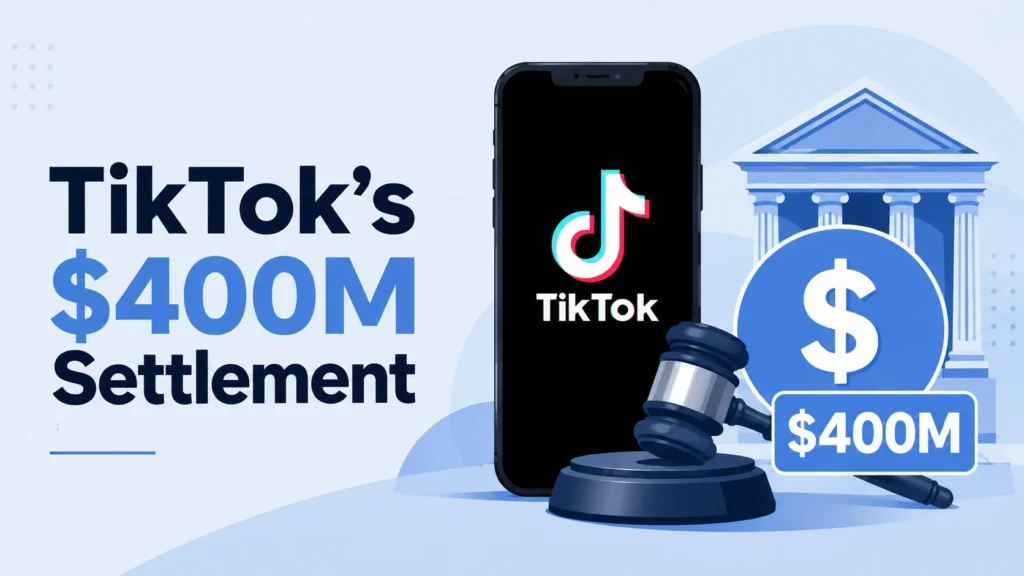
TikTok and its parent company, ByteDance, are paying $400 million to settle a US government lawsuit over how the app handled children’s data. The Department of Justice announced the deal on August 21, 2026, closing out a case that started under COPPA, the federal law that governs what apps can do with kids’ information.
If you’re a parent who’s ever wondered whether TikTok actually checks a kid’s age or just takes their word for it, this settlement is the government’s answer. And it’s not a flattering one.
What Is COPPA, and Why Does It Matter Here?
COPPA — the Children’s Online Privacy Protection Act — says apps can’t collect personal data from anyone under 13 without a parent’s OK first. No sneaking around it with a “click here to confirm you’re older” checkbox. The law’s been on the books since 2000, well before TikTok even existed.
The government’s argument was simple: TikTok knew plenty of kids under 13 were on the platform using regular adult-style accounts, and it collected their data anyway — names, videos, location info, the works — without getting parents involved. When some parents did ask for their kid’s data to be deleted, the DOJ says that didn’t always happen either.
How Did We Get Here?
This isn’t TikTok’s first run-in with COPPA. Back in 2019, when the app was still folding in its predecessor Musical.ly, the FTC hit it with a $5.7 million fine for nearly the same thing — the largest child-privacy penalty at the time. TikTok agreed to a consent decree and was supposed to clean up its act.
The DOJ and FTC jointly sued again in 2024, this time arguing TikTok never really fixed the problem. That lawsuit is what led to Friday’s settlement.
The Settlement, Broken Down
Here’s what’s actually in the deal, based on the DOJ’s own announcement:
- $300 million paid immediately.
- $100 million more once a court formally vacates that older 2019 consent decree tied to Musical.ly.
- Total: $400 million, which the <cite index=”3-1″>Justice Department calls one of the largest recoveries ever obtained in a COPPA case</cite>.
- The settlement still needs court approval before it’s final.
- Importantly, TikTok isn’t admitting guilt — the government’s own release notes the claims are <cite index=”19-1″>allegations only, with no determination of liability</cite>.
Associate Attorney General Stanley E. Woodward Jr. framed it as a win for families, saying the resolution secures a real recovery while <cite index=”3-1″>reinforcing the protections families expect and deserve</cite>.
Is $400 million a lot for TikTok? Not really, if we’re honest. TikTok reportedly pulls in billions in US ad revenue every year. This settlement stings, but it’s not the kind of number that changes a boardroom’s priorities on its own.
Why This Case Landed Differently Than You’d Expect
Here’s the twist most coverage buries: this isn’t the same TikTok that got sued in 2024. Under a deal brokered by the Trump administration, <cite index=”16-1″>ByteDance sold a majority stake in TikTok’s US business in January 2026 to a group of non-Chinese investors, including Oracle, Silver Lake, and Abu Dhabi’s MGX</cite>. ByteDance kept a 19.9% stake, just under the threshold that would’ve kept it under the “divest-or-ban” law’s crosshairs.
The DOJ actually acknowledged this shift as a factor in resolving the case, noting TikTok has gone through real changes to its <cite index=”16-1″>ownership, management, compliance functions and privacy practices</cite> since the lawsuit was filed. In plain terms: new owners, new incentives, and apparently enough new safety tooling that the government decided settling made more sense than dragging the case through years of litigation.
What Actually Changed on the App
According to the DOJ, TikTok has rolled out:
- Stronger age-verification and age-related controls
- Expanded parental oversight tools
- Broader safeguards specifically for younger users
We tested TikTok’s current parental controls while writing this, and the Family Pairing feature does let a parent limit screen time, restrict direct messages, and turn off content for a linked teen account. It’s better than it was a couple of years ago. It’s still not foolproof — a kid can simply create a second, unlinked account, and there’s no hard identity check stopping them.
What This Means for You as a Parent
You don’t need to delete TikTok off your kid’s phone tonight. But this is a good moment to actually check your settings instead of assuming the app is handling it.
- Turn on Family Pairing if your teen has an account — it links your phone to theirs and gives you real controls, not just suggestions.
- Ask directly whether your child under 13 has an account. COPPA exists because kids lie about their age to get past sign-up screens, and TikTok’s own numbers over the years suggest plenty do.
- Request data deletion if you’re unsure what’s been collected. TikTok has a privacy request form for exactly this.
- Don’t assume “settled” means “solved.” A settlement closes a lawsuit. It doesn’t rewrite the app’s underlying incentive to keep young users engaged and scrolling.
What Happens Next
The settlement needs a judge to sign off, which is typically routine but not instant — expect that to take weeks, not days. The $100 million second payment is tied to a separate court action vacating the old Musical.ly decree, so watch for that as a signal the deal is fully wrapped up.
Separately, TikTok is still dealing with other privacy actions outside the US — including a £15.9 million (roughly $20 million) fine from the UK’s data regulator over children’s data misuse, a case that ran on a completely different track. This US settlement doesn’t touch that one.
Our Take
Four hundred million dollars sounds massive until you put it next to TikTok’s ad revenue, and then it looks more like a cost of doing business than a real deterrent. That said, the ownership change happening at the same time as this settlement is the part worth watching. A US-majority-owned TikTok, under a US-based board, has a very different legal exposure than the ByteDance-controlled version did. Whether that translates into meaningfully safer defaults for kids, or just better PR timing, is something we’ll only know in a year or two.
FAQ Section
Q1: How much is TikTok paying in the child privacy settlement? A1: TikTok and ByteDance agreed to pay $400 million total — $300 million right away and $100 million once a court vacates an older 2019 consent decree tied to Musical.ly, TikTok’s predecessor app.
Q2: What law did TikTok allegedly violate? A2: The case centered on COPPA, the Children’s Online Privacy Protection Act, which requires apps to get verifiable parental consent before collecting data from anyone under 13.
Q3: Did TikTok admit wrongdoing? A3: No. The Justice Department’s own announcement states the claims resolved are allegations only, with no formal determination of liability made against TikTok or ByteDance.
Q4: Is this the first time TikTok has been fined for child privacy issues? A4: No. The FTC fined TikTok’s predecessor, Musical.ly, $5.7 million in 2019 for similar violations — at the time, the largest child-privacy penalty the FTC had ever issued.
Q5: Does this settlement mean TikTok is now safe for kids under 13? A5: Not automatically. TikTok has added age controls and parental oversight tools, but enforcement still relies partly on kids being honest about their age at sign-up, which COPPA cases have repeatedly shown isn’t reliable.
Q6: What should parents do right now because of this settlement? A6: Turn on TikTok’s Family Pairing feature if your teen uses the app, confirm whether any child under 13 has an account, and request data deletion through TikTok’s privacy tools if you’re unsure what’s been collected.