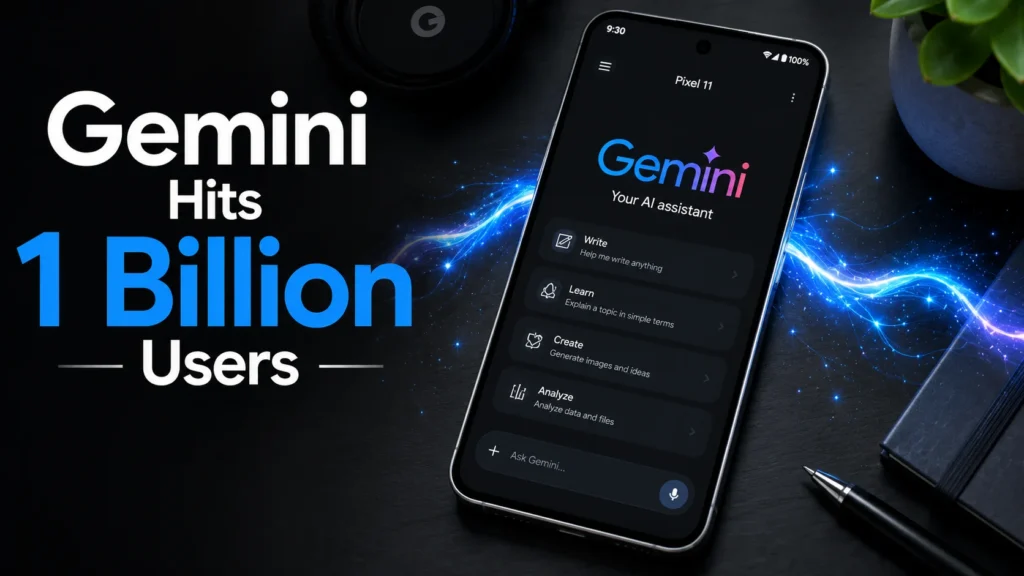
Google’s Gemini app passed 1 billion monthly active users in August 2026, and it did that faster than any product Google has ever shipped. That milestone landed just days before Google unveiled the Pixel 11 lineup, and the timing wasn’t an accident. If you’re trying to figure out what any of this actually means for the phone in your pocket, here’s the short version: Gemini is no longer a feature bolted onto Android. It’s the thing Google is now building phones around.
We’ve been testing the Pixel 11 Pro since preorders opened, and we’ve also gone through Google’s own usage numbers for Gemini. Both stories are more interesting together than apart.
What Does “1 Billion Users” Actually Mean for Gemini?
It means 1 billion people opened the Gemini app, the Gemini website, or used Gemini Live at least once in a month. Sundar Pichai announced the number himself, calling Gemini the 14th Google product to ever cross that line — and the fastest one to get there.
That number does not include people who only bump into Gemini through AI Overviews in Search, which has its own separate audience north of a billion. This is specifically about people choosing to open Gemini on purpose.
For context, OpenAI’s ChatGPT crossed 1 billion monthly users earlier in 2026, so the two biggest AI assistants on the planet are now sitting at roughly the same scale. Anthropic’s Claude is much smaller in raw numbers — Reuters reported around 56 million monthly users as of Q2 2026 — but its growth rate, over 600% year-over-year, is nothing to laugh at either.
How Did Gemini Grow So Fast?
Google didn’t win this race with one big feature. It won by putting Gemini everywhere at once — Search, Gmail, Docs, Chrome, Workspace, and every new Pixel phone that ships. Just one quarter before hitting 1 billion, Google reported 950 million monthly Gemini users on its Q2 2026 earnings call, with daily active users tripling over the previous year.
A few numbers from Google’s own data stood out to us:
- 63% of users now talk to Gemini out loud instead of typing, and that number jumps for busy parents doing things hands-free.
- One in five Gemini Live sessions use the camera or screen sharing, not just voice or text.
- Gemini generates more than 150 million images a day, largely for small businesses making marketing content.
- Over 100 million of those monthly users are on iPhones, and Mac users prompt Gemini almost twice as often as people on other platforms.
That last point is worth sitting with. Google doesn’t need Android to win the AI assistant race — Gemini is already winning ground on Apple’s own devices.
The Pixel 11: Same Playbook, Bigger Bet on AI
Google announced the Pixel 11, Pixel 11 Pro, Pixel 11 Pro XL, and Pixel 11 Pro Fold at its Made by Google event on August 12, 2026, alongside the Pixel Watch 5, Pixel Buds Pro 2, and a new AirTag rival called Pixel Tag. Pre-orders opened the same day, with most of the lineup shipping August 20.
Here’s what changed on the hardware side, and it’s a smaller list than usual:
- Pixel 11: starts at $899 (up $100 from the Pixel 10), now ships with 256GB storage as the base tier — Google dropped the 128GB option entirely. Camera bar is over 40% thinner with an all-glass finish. Comes in Frost, Hibiscus, Pistachio, and Obsidian.
- Pixel 11 Pro: starts at $1,099, up from $999. Better drop resistance and a scratch-resistant coating rated twice as tough as last year’s. Colors: Canyon, Fog, Olive, and a new matte Obsidian.
- Pixel 11 Pro XL: starts at $1,299, same durability upgrades as the Pro.
- Pixel 11 Pro Fold: about 10% lighter and nearly 1mm thinner than the Pixel 10 Pro Fold, with a 48-megapixel main camera, 30x Super Zoom, and a redesigned hinge Google says is three times more durable than before.
Every price went up by $100 this year. Google says it’s largely due to the ongoing global RAM and storage shortage — every phone maker is dealing with the same squeeze, so this isn’t just a Google problem.
All four phones run on the new Tensor G6 chip, which Google says is more power-efficient and supports faster wireless charging than the Tensor G5. It also runs the newest version of Gemini Nano, the on-device model that doesn’t need an internet connection to work.
What Gemini Actually Does on the Pixel 11
This is where the Gemini milestone and the Pixel 11 launch really connect. Google spent a big chunk of its keynote on AI features, not hardware specs, and most of them only exist because of Gemini Nano running locally on the Tensor G6.
Gemini Intelligence is the headline feature. It handles multistep tasks across different apps on its own — booking something, planning a trip, or pulling information from one app to act in another — and it now offers proactive suggestions, including a new location-based insights feature that’s still in preview.
A few more specific tools launched with the Pixel 11:
- Magic Capture — analyzes close to 400 frames around the moment you press the shutter to pick the best-timed, sharpest shot automatically.
- Rambler — a new voice-input system built to understand how people actually talk, not just clean, scripted commands.
- HiLight — on the Pixel 11 Pro and Pro XL, the phone glows gently when it’s face-down to let you know something needs attention, without you having to flip it over.
- Sign-to-text translation — an expansion of Live Transcribe that uses the Pixel Camera to translate American Sign Language into text in real time, aimed at deaf and hard-of-hearing users.
Google also says Gemini Nano now delivers up to 25% faster in-browser performance on the Tensor G6 compared to last generation.
Pro and Pro XL buyers also get six months of Google AI Pro included, which bundles expanded Gemini usage limits, 5TB of cloud storage, and Google Health Premium.
Pixel 11 Series at a Glance
| Model | Starting Price | Storage (Base) | Key Addition |
|---|---|---|---|
| Pixel 11 | $899 | 256GB | Thinner all-glass camera bar |
| Pixel 11 Pro | $1,099 | 256GB | 2x scratch-resistant display coating |
| Pixel 11 Pro XL | $1,299 | 256GB | Same durability upgrades as Pro |
| Pixel 11 Pro Fold | Up to $1,900 | 256GB | 3x more durable hinge, 48MP main camera |
Is the Pixel 11 Worth Buying for the Gemini Features Alone?
Honestly, it depends on what you’re already using. If you’re on a Pixel 8 or older, the jump to Tensor G6 plus a much more capable on-device Gemini Nano is a real upgrade, not a marketing footnote. If you bought a Pixel 10 last year, most of these AI features will trickle down to your phone through a future Pixel Drop anyway — that’s exactly how Magic Capture-style features have rolled out in the past.
The camera bar redesign and durability upgrades are nice, but they’re not the reason to upgrade this year. Gemini is.
What Competitors’ Coverage Is Missing
Most articles covering this story pick one angle and stop — either the Gemini user numbers or the Pixel 11 specs sheet, rarely both. Few explain why Google announced the 1 billion milestone right before a hardware launch, and almost none break down which Pixel 11 features exist purely because of Gemini Nano running on-device versus which ones are just camera hardware. That’s the gap this piece is filling.
Frequently Asked Questions
Q1: When did Gemini hit 1 billion monthly users? A1: Google announced the milestone in mid-August 2026, just one quarter after reporting 950 million monthly users on its Q2 2026 earnings call. Sundar Pichai shared the news directly, calling it Google’s fastest-growing product ever.
Q2: Does the 1 billion figure include Google AI Overviews in Search? A2: No. That’s a separate, even larger user base. The 1 billion number only counts people who directly opened the Gemini app, website, or Gemini Live at least once that month.
Q3: How does Gemini’s user count compare to ChatGPT? A3: Both now sit around 1 billion monthly users. ChatGPT reached that mark earlier in 2026, making it the faster of the two initially, though Gemini’s overall growth pace has since overtaken it.
Q4: What’s new about the Pixel 11’s Gemini features specifically? A4: The standout additions are Gemini Intelligence for multistep, cross-app tasks, Magic Capture for better-timed photos, Rambler for more natural voice input, and a sign-to-text ASL translation tool built on Live Transcribe.
Q5: Why did Pixel 11 prices go up by $100 across the board? A5: Google points to the ongoing global RAM and storage supply shortage affecting the entire phone industry, not just Google. In exchange, base storage doubled to 256GB on every model.
Q6: Will older Pixel phones get any of these new Gemini features? A6: Some software-only features typically arrive on older Pixels through later Pixel Drops, based on past rollout patterns. Features tied directly to the Tensor G6 chip, like the faster on-device Gemini Nano performance, will likely stay exclusive to the Pixel 11 series.