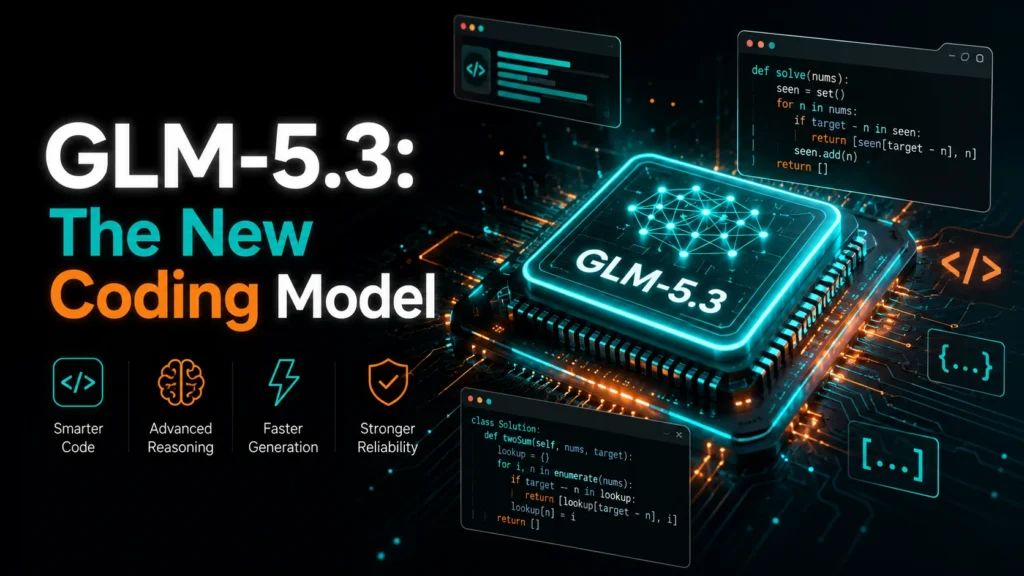
Z.ai released GLM-5.3 on August 14, 2026, and it’s already the model developers are asking about. Short answer: it’s a coding and agentic-workflow model built on the same base as GLM-5.2, with all its gains coming from post-training — and Z.ai says it’s now the strongest open-weights coder on the market.
That’s the pitch, anyway. I spent the last couple of days going through the launch numbers, the pricing pages, and what early users are reporting. Some of it holds up. Some of it needs an asterisk.
What Is GLM-5.3?
GLM-5.3 is Z.ai’s (formerly Zhipu AI) latest large language model, built specifically for software engineering and long-running coding agents. It runs at 743 billion parameters and, notably, uses the exact same base model as GLM-5.2. Nothing changed at the architecture level — Z.ai poured its post-training budget into more realistic engineering tasks instead.
That’s a meaningful shift in strategy. Z.ai’s own team described some of the training tasks as comparable to several days of senior-engineer work: identify a problem, dig into it, make the change, verify it, ship it. Not toy problems.
The model also picked up a cybersecurity skill nobody planned for. More on that below.
GLM-5.3 Benchmarks: How It Actually Performs
Here’s where I’d push back on the marketing a little. Z.ai’s headline claim is a 50% improvement over GLM-5.2 on its own internal Code Bench. That’s a vendor-run test on a private benchmark, so treat it as a starting point, not gospel.
What’s independently interesting: GLM-5.3 got a lot more token-efficient. At max effort, it hits 34.5% task completion using roughly 75,000 output tokens, compared to GLM-5.2’s 23.4% at 96,000 tokens. Z.ai says that beats Claude Opus 4.8 on token economy, though it still trails Claude Fable 5, which reaches 39.5% at max effort on the same internal test.
On public, third-party-style benchmarks, the picture is more mixed:
| Benchmark | GLM-5.3 | Claude Fable 5 | GPT-5.6 Sol | Kimi K3 |
|---|---|---|---|---|
| Terminal-Bench 3.0 | 28.3 | 33.7 | 34.6 | — |
| DeepSWE v1.1 | 66.9 | 69.7 | — | 67.5 |
| Agents’ Last Exam | 28.5 | — | — | — |
| GDPval-AA v2 | 1,769 pts | — | — | — |
So GLM-5.3 is genuinely good — best-in-class among open-weight models on most of these — but it’s not beating the closed frontier. It’s closing the gap, not erasing it. I’d call that an honest win, not the outright victory the launch post implies.
The Cybersecurity Angle Nobody Expected
This is the part of the release that surprised me most. Z.ai says cybersecurity capability grew faster than they anticipated as they scaled post-training — enough that they built dedicated vulnerability-finding environments for the model.
Working with Chinese security teams, Z.ai reports the model helped surface 2,436 vulnerabilities across 269 projects, some in codebases up to 40 years old. On CyberGym (testing whether a model can spot and validate flaws from source code), GLM-5.3 scores 84.5%, up from 77.2% on GLM-5.2. On ExploitBench, which tests deeper exploitation reasoning, it more than doubled its predecessor’s score.
Z.ai is upfront that the model is stronger at the early stages — reviewing and verifying vulnerabilities — than at building full exploit chains. That’s a fair distinction. Finding a flaw and weaponizing it are very different problems, and the harder one is still mostly out of reach.
Context Window and Technical Specs
GLM-5.3 ships with a 1-million-token context window and a 128,000-token completion ceiling. That’s enough to hold a genuinely large codebase in a single session. If you’re working inside Claude Code, you can access the extended window through the glm-5.3[1m] model tag with a matching compaction setting.
A few other specs worth knowing:
- Model ID:
glm-5.3 - Thinking: cannot be disabled — GLM-5.3 always reasons before responding
- Reasoning effort levels: low, high, max
- Parameters: 743 billion
How Do You Actually Use GLM-5.3?
Right now, there are two doors in, and only one of them is fully open.
- GLM Coding Plan / ZCode — live today, rolled out to all existing subscribers on launch day. This works inside agent tools like Claude Code, Cline, Roo Code, and OpenCode through Anthropic-compatible or OpenAI-compatible endpoints.
- Standalone API and open weights — staged. Z.ai says raw API access and downloadable weights are coming roughly two weeks after launch, once safety review and hardening wrap up.
If you were hoping to pip install your way to self-hosting tonight, that’s not happening yet. The practical path today is subscribing to the Coding Plan and pointing your existing coding agent at it.
GLM-5.3 Pricing: What It Costs
GLM-5.3 doesn’t have its own separate price tag — it’s bundled into the GLM Coding Plan, and the plan itself just moved to a points-based quota system that meters input, cached input, and output tokens separately.
The three subscription tiers:
- Lite — $18/month, for light work on small repos
- Pro — $72/month, for daily development on mid-sized codebases
- Max — $160/month, for heavy, large-project work
A 30% introductory discount brings those down to roughly $12.60, $50.40, and $112 for early subscribers. Annual billing works out to about $151, $605, and $1,344 a year across the three tiers.
Two cost-saving details worth knowing: calls made outside peak hours (14:00–18:00 UTC+8, weekdays) consume half the standard quota, and ZCode is running a limited 1.5x quota boost through August 31, 2026.
There’s no published standalone API price for glm-5.3 yet — if you’re calling it directly through code rather than through an agent tool, you’re stuck waiting, or using GLM-5.2’s rate as a rough (and not guaranteed accurate) stand-in.
GLM-5.3 vs. Claude Fable 5: Should You Switch?
Honestly, it depends on what you’re optimizing for.
Pick GLM-5.3 if: cost matters more than squeezing out the last few points of benchmark performance, you’re already running a Coding Plan subscription, or you specifically care about vulnerability-scanning during code review.
Stick with Claude Fable 5 if: you need the higher ceiling on harder agentic tasks — it’s still ahead on Terminal-Bench 3.0, DeepSWE, and Z.ai’s own internal benchmark at max effort — or you need production-stable API pricing today instead of “in about two weeks.”
For a lot of day-to-day coding work, the gap between the two won’t be the thing that slows you down. For genuinely hard, multi-file, long-horizon engineering tasks, the closed frontier models still have room to spare.
What Competitors Are Missing
Most of the coverage I read treated the vendor benchmark numbers as final results instead of a starting point for verification. A few also blurred GLM-5.2 and GLM-5.3 pricing together, which is misleading since GLM-5.3 doesn’t have a confirmed standalone API rate yet. None of the pieces I found walked through what it actually takes to switch a live Claude Code setup over to GLM-5.3 — the [1m] context tag, the compaction setting, and the endpoint config.
Frequently Asked Questions
Q1: What is GLM-5.3 used for? A1: GLM-5.3 is built for software engineering — writing code, fixing bugs, running long autonomous coding sessions, and reviewing source code for security vulnerabilities. It’s designed to work inside agent tools like Claude Code rather than as a general chatbot.
Q2: Is GLM-5.3 open source? A2: Not yet. It’s currently available only through the GLM Coding Plan and ZCode. Z.ai says the model weights will be released on Hugging Face roughly two weeks after the August 14, 2026 launch, pending safety review.
Q3: How much does GLM-5.3 cost? A3: It’s included in every GLM Coding Plan tier: Lite at $18/month, Pro at $72/month, and Max at $160/month, with a 30% introductory discount available. There’s no standalone per-token API price published yet.
Q4: Is GLM-5.3 better than Claude? A4: It beats Claude Opus 4.8 on token efficiency in Z.ai’s internal testing, but it trails Claude Fable 5 on that same test and on several public benchmarks like Terminal-Bench 3.0 and DeepSWE v1.1. It’s best-in-class among open-weight models, not the overall frontier leader.
Q5: Can I use GLM-5.3 in Claude Code? A5: Yes. Z.ai documents a path to run GLM-5.3 inside Claude Code through an Anthropic-compatible endpoint, including a glm-5.3[1m] tag for the full 1-million-token context window.
Q6: What’s new in GLM-5.3 compared to GLM-5.2? A6: The base model is identical — the gains all come from post-training. GLM-5.3 is more token-efficient, scores higher on coding and agentic benchmarks, and picked up a much stronger cybersecurity vulnerability-detection capability that Z.ai says outpaced their own expectations during training.