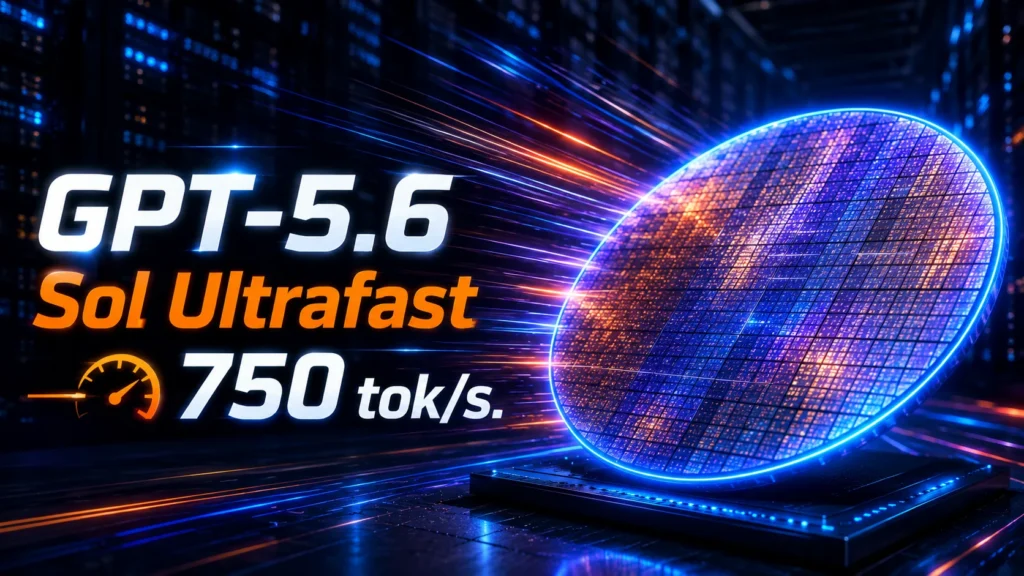
Cerebras just started running OpenAI’s most capable model, GPT-5.6 Sol, at 750 output tokens per second. That’s the headline. The real question is whether it changes anything for people who actually build with AI, or whether it’s another benchmark chart that looks great in a press release and means nothing in practice.
GPT-5.6 Sol Ultrafast is a new OpenAI API tier, powered by Cerebras hardware, that runs the full GPT-5.6 Sol model up to 14x faster than standard processing — without a smaller or dumbed-down version of the model. It launched August 13, 2026, in limited preview. We’ll walk through the numbers, where they come from, and who can actually get access right now.
What Is GPT-5.6 Sol Ultrafast?
Ultrafast is a service tier inside the OpenAI API. It’s not a new model — it’s the same GPT-5.6 Sol, just served on Cerebras’s wafer-scale chips instead of standard GPU infrastructure. OpenAI and Cerebras say the intelligence is identical to Standard mode. Only the speed changes.
Cerebras CEO Andrew Feldman framed it simply: speed and intelligence don’t have to trade off against each other anymore. That’s the pitch, anyway. Historically, if you wanted a smarter model, you accepted it would be slower. Ultrafast is OpenAI and Cerebras betting that assumption is outdated.
How Fast Is It, Really?
Here’s where it gets concrete:
- Up to 750 output tokens per second
- Up to 14x faster than GPT-5.6 Sol on Standard processing
- 11x faster than Claude Fable 5’s reported output speed, and 5x faster than Claude Opus 4.8 in Fast mode, based on figures from Artificial Analysis
Cerebras also ran GPT-5.6 Sol Ultrafast through Humanity’s Last Exam — a brutal, 2,500-question benchmark built around PhD-level material in chemistry, economics, and literature. Ultrafast finished the entire set in 11 hours and 11 minutes. By Cerebras’s own comparison, Claude Fable 5 needed 78 hours and 27 minutes for comparable accuracy — nearly 7x slower.
On GDP-Val, a benchmark built around economically valuable knowledge work like legal drafting and financial modeling, Cerebras reports a 5.6x end-to-end speedup with no drop in output quality.
Those are Cerebras’s numbers, published in its own blog post and press release. They’re plausible given how the hardware works, but they’re not independently audited, so treat them as vendor-reported until third parties run their own tests.
Why Is It So Much Faster? The Hardware Behind It
This is the part most coverage skips, and it’s the actual interesting bit.
Regular GPU inference has a bottleneck: the chip has to keep shuttling model weights between fast on-chip memory and slower off-chip storage. That shuttling — not the math — is usually what limits token generation speed on large models.
Cerebras’s Wafer-Scale Engine sidesteps that. Each wafer-sized chip carries 44 GB of SRAM directly on-chip, big enough to hold the model weights without constantly moving data back and forth. No shuttling, no bottleneck, much higher token throughput. It’s a genuinely different chip architecture, not just more GPUs stacked together — which is why the speedup isn’t incremental, it’s a multiple.
Who Can Actually Use It Right Now
This is the honest part of the story people skip past: almost nobody, yet.
- Available only through the OpenAI API — no Ultrafast option in ChatGPT or Codex for now
- Limited preview, restricted to a select group of customers
- No public pricing has been announced
- Access is expected to expand “as capacity grows,” which is a fair way of saying: wait for a waitlist form to turn into an email
If you’re a developer excited to swap your endpoint over tonight, you can’t — unless OpenAI has already reached out to you. Everyone else can sign up to get notified.
What This Means in Practice
Where does 750 tokens per second actually matter? Not for a chatbot reply — most people can’t read faster than the model already types. It matters for:
- Agentic workflows that chain many model calls together, where latency compounds
- Real-time products — voice assistants, live coding copilots, financial or incident-response tools where a few extra seconds is the difference between useful and useless
- Bulk knowledge work — running large batches of legal review, financial analysis, or research tasks where total wall-clock time is the real cost
It’s less exciting for a single back-and-forth chat and much more exciting for anyone building something that fires off dozens or hundreds of model calls per task.
The Honest Trade-Offs
A few things worth sitting with before you get too excited:
- The benchmarks are Cerebras’s own. They’re specific and plausible, but they weren’t run by a neutral third party. Wait for independent replications before betting a product roadmap on the exact multipliers.
- This isn’t a general availability launch. It’s a preview for a “select group of customers.” Most of the excitement online right now is speculative, because almost nobody has hands-on access yet.
- No pricing means no real cost comparison. Speed is only half the equation — if Ultrafast costs meaningfully more per token, the calculus for high-volume use cases changes.
- This deal sits inside a much bigger partnership. Cerebras and OpenAI have reportedly signed a $10 billion agreement, so Ultrafast is really the first visible product of a much longer-term hardware relationship, not a one-off feature.
Bottom Line
Cerebras running GPT-5.6 Sol at 750 tokens per second is a real technical achievement — the Wafer-Scale Engine’s on-chip memory genuinely removes a bottleneck that GPU inference can’t avoid. But right now it’s a preview, not a product. If you build agentic or high-throughput AI workflows, this is worth signing up for updates on. If you’re evaluating it for a chatbot, it’s not going to change your day.
FAQ
Q1: What is GPT-5.6 Sol Ultrafast? A1: It’s a new OpenAI API service tier where GPT-5.6 Sol runs on Cerebras hardware instead of standard GPUs, hitting up to 750 output tokens per second — up to 14x faster than Standard processing, with the same model intelligence.
Q2: Is GPT-5.6 Sol Ultrafast a different, smaller model? A2: No. OpenAI and Cerebras both state it’s the same GPT-5.6 Sol model as Standard mode. Only the serving hardware and resulting speed change, not the model’s capabilities.
Q3: How do I get access to Ultrafast mode? A3: It’s currently limited preview only, available to a select group of OpenAI API customers. There’s no general access yet — interested developers can sign up through OpenAI’s waitlist form for updates.
Q4: How much does GPT-5.6 Sol Ultrafast cost? A4: Pricing hasn’t been announced. Since it’s still a limited preview, OpenAI hasn’t published rate cards for Ultrafast mode, so cost comparisons against Standard processing aren’t possible yet.
Q5: How does Cerebras make GPT-5.6 Sol run this much faster? A5: Cerebras’s Wafer-Scale Engine chip stores 44 GB of model weights directly in on-chip SRAM, avoiding the constant data shuttling between on-chip and off-chip memory that slows down standard GPU inference.
Q6: Is Ultrafast mode available in ChatGPT? A6: Not currently. Ultrafast is only available through the OpenAI API for now — there’s no announced access through ChatGPT’s consumer interface or through Codex.